
- By stoneguysny
- In Blog
Limestone Lobby Floors in Luxury Residential Buildings: A Maintenance Guide for Boards and Managers
There is a reason limestone appears in so many of New York City’s most distinguished residential buildings. Pre-war co-ops on Park Avenue, classic doorman buildings on the Upper West Side, landmark limestone facades and lobby floors throughout Manhattan — the material carries a weight of permanence and refinement that newer surfaces struggle to replicate. When
There is a reason limestone appears in so many of New York City’s most distinguished residential buildings. Pre-war co-ops on Park Avenue, classic doorman buildings on the Upper West Side, landmark limestone facades and lobby floors throughout Manhattan — the material carries a weight of permanence and refinement that newer surfaces struggle to replicate. When a building has original limestone floors, it has something that cannot be recreated at any price: authentic character that has been part of the building since the day it opened.
That character comes with a responsibility that many co-op and condo boards underestimate until they’re looking at a floor that has been quietly damaged by years of improper care.
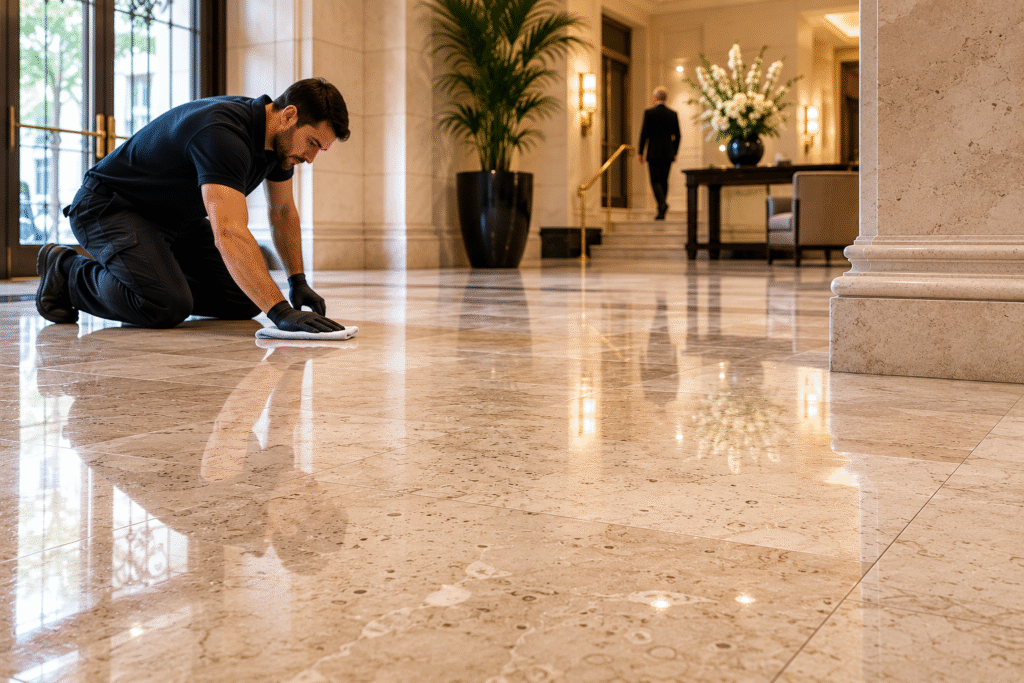
Limestone is among the most beautiful natural stones used in residential buildings. It is also among the most demanding to maintain correctly. Its sensitivity to cleaning products, its porosity, its reaction to moisture, and its vulnerability to the specific chemicals found in common commercial cleaners make it a material that requires genuine expertise — both from the professional stone care company the building hires and from the cleaning contractors who work on it every day.
This guide is specifically for co-op and condo boards, managing agents, and building managers responsible for luxury residential buildings with limestone lobby floors. It covers what limestone actually needs, what commonly goes wrong, and how to build a maintenance program that protects one of the building’s most significant and irreplaceable assets.
Why Limestone Is So Common in Classic NYC Residential Lobbies
Limestone’s prevalence in NYC’s historic residential buildings is not accidental. It was a premium specification in the early to mid-twentieth century, chosen by architects and developers who were building for permanence and prestige. The stone’s warm, muted palette — creams, taupes, and soft grays — creates a lobby atmosphere that is immediately recognizable as belonging to a certain caliber of building.
Many of New York’s finest pre-war buildings were constructed when limestone from France, Italy, and domestic quarries was the material of choice for lobby floors, wall cladding, baseboards, and decorative elements. These installations were built to last, and in buildings that have maintained them properly, they have. Lobby floors that were installed eighty or a hundred years ago, properly cared for, still look exceptional today.
The challenge is that the buildings themselves have changed. Original maintenance protocols — if they existed at all — were not designed for the cleaning products, foot traffic patterns, and operational realities of modern building management. What worked in 1935 is not what your current cleaning contractor is doing, and the gap between appropriate limestone care and what most cleaning crews actually practice is where the damage accumulates.
The Maintenance Paradox: Elegant but Easily Damaged
Limestone’s sensitivity is not a flaw — it is a characteristic of its mineralogical composition. Limestone is a sedimentary rock composed primarily of calcium carbonate, the same compound that makes marble and travertine reactive to acids. What distinguishes limestone from marble is its typically higher porosity and softer surface, which make it more vulnerable to both chemical damage and physical wear.
The maintenance paradox is this: limestone looks like it should be cared for gently, and it should be — but the products and methods that seem gentle, or that are marketed as appropriate for stone, are frequently anything but.
Consider the most common scenario in NYC residential buildings. A cleaning contractor is hired who has extensive experience with standard commercial floors. They bring their usual products — a tile cleaner, a general-purpose disinfectant, perhaps a degreaser for the area near the building entrance. These products are probably perfectly appropriate for the ceramic tile or vinyl flooring in the building’s service areas. On limestone, they cause damage with every application.
Acidic cleaners etch the calcium carbonate surface, leaving dull, white, or hazy marks that cannot be cleaned away because they are in the stone, not on it. Alkaline cleaners at incorrect dilutions strip the stone’s sealer and open its pores to moisture and staining. Products that leave a waxy or filmy residue build up over time and must be professionally stripped before any restoration work can be performed — adding cost to what should have been straightforward maintenance.
This is not hypothetical. It is the most common finding our team encounters when assessing limestone lobby floors in NYC residential buildings that have experienced maintenance problems. The stone itself is often in better structural condition than it appears — the damage is frequently a layer of inappropriate cleaning product residue, compounded by etching from acidic cleaners, sitting on top of stone that could be restored to excellent condition with the right professional treatment.
What Building Cleaning Crews Commonly Do Wrong
Understanding the specific practices that cause limestone damage empowers building managers to brief their cleaning contractors correctly — and to identify when a contractor is using methods that are harming the stone they’re supposed to be maintaining.
Using acidic cleaners Any cleaner with a pH below 7 is potentially damaging to limestone. This includes many bathroom cleaners, tile descalers, grout cleaners, and general-purpose cleaners. Even products marketed as “stone cleaners” may be acidic. The only appropriate pH range for daily limestone cleaning is neutral — between 6.5 and 7.5. Building managers should require contractors to provide the pH documentation for every product they use on limestone surfaces.
Using vinegar or citrus-based products These are acidic by nature and will etch limestone on contact. They appear frequently in “natural cleaning” approaches that cleaning crews use without realizing their effect on calcium carbonate stone.
Steam mopping Steam mops introduce concentrated heat and moisture simultaneously — a combination that opens limestone’s pores, can cause micro-fracturing at the surface, and drives moisture into the stone where it promotes discoloration and sub-surface damage. Steam should never be used on limestone floors.
Leaving standing water after mopping Limestone is porous. Water that sits on the surface — or worse, in the grout lines — penetrates the stone and can cause watermarking, efflorescence (white mineral deposits that appear as the water evaporates), and over time, sub-surface damage. After any wet cleaning, limestone should be dried promptly with clean, dry mops or towels.
Over-wetting the surface Related to the above, some cleaning crews use a wet-mop technique that applies significantly more water than necessary. On limestone, less moisture is always better. A lightly dampened mop with a pH-neutral cleaner, followed by dry mopping, is the correct approach.
Using abrasive pads or brushes Even pads labeled “non-scratch” for standard floors may be too abrasive for polished limestone. Abrasive cleaning tools scratch the surface and accelerate the loss of the stone’s polished finish over time.
Providing your cleaning contractor with written product specifications — listing the approved cleaner by name and specifying that no substitutions are permitted without building manager approval — is one of the most practical steps a building manager can take to protect limestone floors from cleaning-related damage.
Concerned About How Your Building’s Limestone Is Being Maintained?
Stone Guys NY offers limestone lobby assessments for NYC residential buildings. We’ll evaluate the current condition of your floors and identify any cleaning-related damage before it compounds further.
Schedule a Free Limestone Assessment for Your Building →
The Right Maintenance Protocol for Luxury Residential Limestone
A correct maintenance protocol for limestone lobby floors in a NYC residential building has both a daily component — managed by the building’s cleaning contractor — and a professional component handled by a qualified stone care provider on a scheduled basis.
Daily maintenance (cleaning contractor) Dry dust mopping once or twice daily to remove grit and debris before it becomes abrasive under foot traffic. Damp mopping with a pH-neutral stone cleaner, diluted per manufacturer specifications, using a well-wrung mop that deposits minimal moisture. Prompt blotting of any spills with a clean, dry cloth — never wiping or spreading. Dry mopping after wet cleaning to remove residual moisture.
Monthly or bi-monthly (professional) A stone care technician performs a deep clean using professional-grade, stone-appropriate products and equipment. The visit also includes a condition inspection — noting any emerging etching, staining, grout deterioration, or areas of wear — and documentation for the building’s maintenance records.
Every 6 to 12 months (professional) Professional re-polishing to restore the limestone’s surface finish and address accumulated wear. The polishing interval depends on traffic volume — a busy co-op lobby with a doorman building’s full complement of deliveries and residents will need more frequent attention than a smaller boutique building. Re-sealing with a penetrating sealer appropriate for limestone follows every polishing service.
As needed (professional) Stain treatment, grout repair, chip filling, and etch removal addressed promptly when identified rather than allowed to worsen. A standing service relationship ensures responsive attention when unplanned issues arise.
This protocol mirrors the approach we describe in detail for marble surfaces in our guide to marble lobby maintenance for NYC building managers, with modifications specific to limestone’s higher porosity and sensitivity. The underlying principle is the same: consistent professional care costs less and delivers better results than reactive restoration.
Communicating Stone Care Standards to Your Cleaning Contractor
One of the most consequential decisions a building manager makes for limestone floor maintenance is how they onboard and brief their cleaning contractor. Most cleaning companies will follow the building’s specifications if those specifications are clear, written, and enforced. The problem is that most buildings don’t provide them.
A practical briefing for a cleaning contractor working on limestone lobby floors should include:
- A written list of approved cleaning products, with brand names and dilution ratios
- An explicit prohibition on any acidic, alkaline, or abrasive products not on the approved list
- Instructions for mop wetness (well-wrung, not soaking) and dry mopping after wet cleaning
- A requirement to blot spills immediately and notify building management of any significant spills
- A prohibition on steam mops, abrasive pads, and scrubbing brushes on limestone surfaces
- A contact protocol for reporting any observed damage or unusual surface conditions
This briefing should be provided in writing at onboarding and reviewed whenever a cleaning contractor brings new staff into the building. It should also be reinforced periodically by the building manager during routine walkthroughs — not as a punitive exercise, but as a way of demonstrating that the building takes its stone care standards seriously.
Buildings that maintain these standards consistently protect their limestone investment. Buildings that leave cleaning protocol to contractor discretion accumulate damage that eventually requires professional correction — at a cost that compounds with every year the appropriate standards are not enforced.
Sealing Limestone: Frequency and Importance
Sealing is the primary protective measure for limestone floors, and it is the maintenance task most frequently deferred in residential buildings because the consequences of deferral are not immediately visible.
A penetrating (impregnating) sealer enters limestone’s pores and creates a hydrophobic barrier that resists liquid absorption without altering the stone’s surface appearance or texture. The sealer does not make the stone impermeable — it buys time when spills occur, preventing immediate absorption and allowing for cleanup before staining sets in.
Without an effective sealer, limestone absorbs liquids directly. A water spill that would bead on a properly sealed floor is absorbed within minutes on unsealed limestone, potentially leaving a permanent mark.
In a residential lobby environment, limestone should be re-sealed every twelve to eighteen months. The water bead test provides a simple field check: apply a small amount of water to the surface in an inconspicuous area. If it beads up and sits on the surface, the sealer is effective. If it absorbs within a few minutes, re-sealing is overdue.
Re-sealing should always follow professional polishing — the mechanical polishing process opens the stone’s pores and removes existing sealer, leaving the surface unprotected until it is re-sealed. Any professional service that includes polishing but omits re-sealing is leaving the building with a polished but unprotected floor.
Our limestone restoration and maintenance services include re-sealing as a standard component of every polishing service — not as an optional add-on — because protecting the restored surface is inseparable from the restoration itself.
When Professional Restoration Is Needed
Despite best efforts, limestone lobby floors in active residential buildings will periodically require professional restoration beyond routine maintenance. The indicators that restoration — rather than maintenance — is the appropriate response include:
Widespread etching that polishing alone cannot address If acid damage has penetrated below the surface layer that polishing reaches, honing — a more aggressive mechanical process — is needed to remove the damaged layer and expose undamaged stone beneath. This is a professional intervention that requires assessment before treatment.
Deep staining that doesn’t respond to surface treatment Stains that have penetrated deeply into porous limestone may require poultice treatment — a professional technique that draws the staining substance out of the stone over an extended period. This is distinct from surface cleaning and requires specific knowledge of the staining agent and the appropriate poultice compound.
Significant grout deterioration across large areas When grout in a limestone tile installation has deteriorated significantly — dark throughout, recessed, crumbling in places — a comprehensive grout restoration is more appropriate than spot treatment. This involves removing deteriorated grout, re-grouting with matching material, and sealing the new grout.
Surface inconsistency from years of inconsistent maintenance Buildings where limestone maintenance has been inconsistent over many years often develop a floor that looks patchy — different areas at different stages of wear and polish, creating an inconsistent appearance that no amount of cleaning will resolve. A full professional re-polishing of the entire floor, followed by a consistent maintenance program, is the solution.
For buildings whose limestone floors have reached this point, the conversation about restoration is also the right time to establish the maintenance program that prevents the situation from recurring. Our article on stone care contracts for NYC buildings covers how to structure that ongoing relationship effectively.
Your Building’s Limestone Deserves Expert Care
Limestone lobby floors in NYC’s finest residential buildings are irreplaceable assets. Stone Guys NY provides the specialized expertise and consistent care these surfaces require — from daily cleaning protocol guidance to full professional restoration and maintenance programs.
Contact Stone Guys NY for a Free Limestone Lobby Assessment →
Stone Guys NY provides professional limestone, marble, granite, terrazzo, travertine, and natural stone restoration and maintenance for luxury residential buildings, co-ops, condos, and commercial properties across New York City. Call us at (888) 786-6369 or email info@StoneGuysNY.com.