
- By Escala SEO
- In Blog
Limestone Lobby Floor Restoration for NYC Buildings
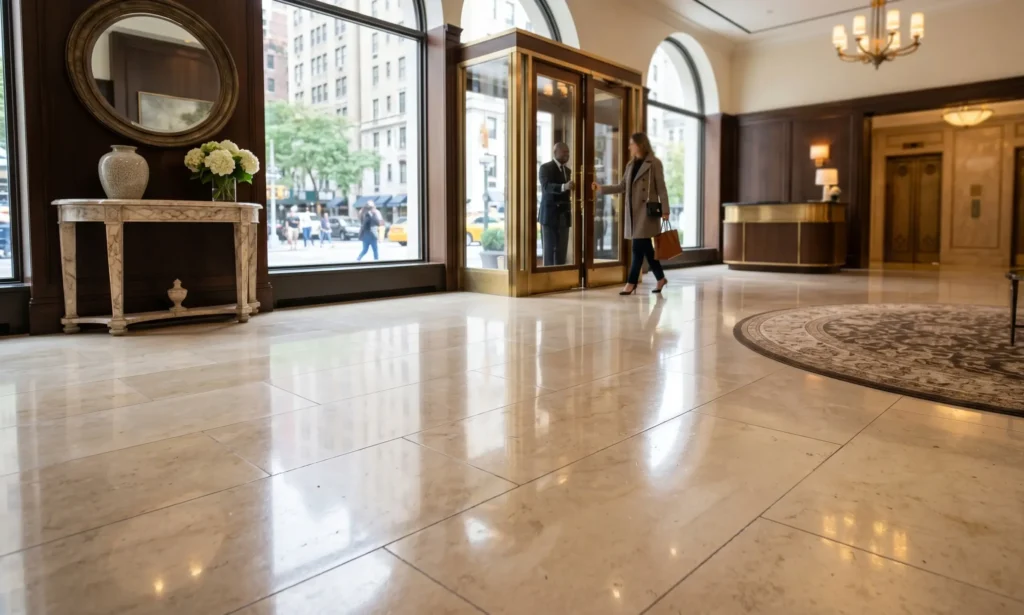
In New York City, a building’s lobby does more than connect the entrance to the elevator bank. It sets expectations. It communicates how the property is managed. For residents, tenants, and guests, it is the first and last thing they see on every visit — and in a competitive NYC real estate market, first impressions carry real weight.
When a limestone lobby floor is clean, polished, and well-maintained, it signals professionalism and care. When it is dull, scratched, stained, or worn down the center from years of foot traffic, it tells a different story — one that reflects poorly on the entire building, regardless of how well everything else is maintained.
For property managers, condo board members, building owners, hotel operators, and facilities directors throughout New York City, limestone lobby floor restoration is not a cosmetic luxury. It is a practical investment in the property’s appearance, longevity, and value. This guide explains what causes limestone floors to deteriorate in NYC buildings, what the professional restoration process involves, and how to keep lobby floors looking their best long after the work is done.
Why Limestone Lobby Floors Wear Down in NYC
Limestone is a naturally elegant stone — warm, refined, and well-suited to the grand lobbies found throughout Manhattan, Brooklyn, and the other boroughs. But it is also a calcium carbonate stone, which means it is chemically reactive and physically soft relative to other commercial flooring materials like granite or concrete.
In a New York City building lobby, limestone faces an exceptionally demanding environment:
Heavy daily foot traffic High-rise residential buildings, office towers, boutique hotels, and mixed-use properties can see hundreds or thousands of foot traffic events per day. Every footfall grinds microscopic abrasive particles against the stone surface, gradually eroding the finish.
Salt and grit from sidewalks From November through March, NYC sidewalks are treated with rock salt, sand, and de-icing chemicals. Residents and delivery personnel track this material directly onto lobby floors, where it acts as a fine abrasive and introduces chloride compounds that can chemically attack limestone.
Rain, snow, and moisture Water tracked in from outside carries dissolved salts and minerals that leave deposits as they evaporate. In porous limestone, this moisture can also penetrate beneath the surface and cause efflorescence — white, powdery mineral deposits that push up through the stone from within.
Rolling carts, luggage, and deliveries Move-ins, move-outs, package deliveries, and service carts create concentrated wear patterns, scratches, and gouges that accelerate damage well beyond what foot traffic alone would cause.
Improper cleaning chemicals This is one of the most prevalent and underappreciated causes of limestone floor deterioration in commercial buildings. Cleaning staff often use general-purpose floor cleaners, disinfectants, or acidic products that are incompatible with limestone. Over time, these products etch the surface, strip any protective sealer, and leave a dull, hazy finish that no amount of mopping will reverse.
Lack of scheduled professional maintenance Limestone floors that receive only surface-level cleaning — without periodic professional honing, polishing, and resealing — accumulate damage year over year. What would have been a straightforward restoration after two years of use becomes a major project after five.
Signs Your Limestone Lobby Needs Restoration
Property managers and building staff often recognize that a lobby floor looks worn but are unsure whether the issue requires professional attention or just better daily cleaning. These are the key signs that restoration — not cleaning alone — is needed:
- Dull or flat finish where the stone no longer reflects light evenly
- Visible traffic lanes — worn paths down the center of the floor that are noticeably duller than the surrounding stone
- Scratches and scuff marks that remain after cleaning
- Etch marks — dull, slightly rough patches caused by acidic substances or cleaners
- Staining from spills, tracked-in materials, or cleaning chemicals
- Uneven sheen where some areas look polished and others look matte
- Grout lines that appear dark, stained, or recessed, making the floor look dirty even after mopping
- Hazy or cloudy surface that does not respond to cleaning
- White mineral deposits or efflorescence that reappear after being wiped away
If several of these signs are present simultaneously, the floor has moved beyond the reach of routine maintenance and requires professional limestone restoration.
Limestone Cleaning vs. Limestone Restoration
These two terms are sometimes used interchangeably, but they describe very different scopes of work — and understanding the distinction matters when making decisions about building maintenance.
Limestone cleaning refers to the removal of surface-level soil, dust, residue, and light buildup using appropriate stone-safe cleaning products and equipment. It is an ongoing maintenance task that should be performed regularly by building staff or a cleaning service. Cleaning maintains the current condition of the floor; it cannot improve it.
Limestone restoration is a comprehensive process that addresses the condition of the stone itself — not just the surface layer of dirt. It may include deep cleaning, stain treatment, honing to remove scratches and etch marks, polishing to restore the desired finish level, crack or chip repair, and sealing to protect the restored surface. Restoration actually improves the appearance of the stone, reversing damage that has accumulated over months or years.
For NYC building lobbies that show visible wear, dullness, or damage, cleaning alone will not produce a meaningful improvement. Restoration is what returns the floor to a condition that looks — and functions — as intended.
The Professional Limestone Restoration Process
Stone Guys NY’s approach to commercial limestone restoration follows a structured, multi-step process designed to address every aspect of the floor’s condition and deliver consistent, lasting results.
1. Inspection and stone identification Before any work begins, a technician inspects the floor to assess the type of limestone, current finish level, extent of damage, presence of any previous coatings or treatments, and specific problem areas. This informs the equipment, abrasive sequence, and products that will be used.
2. Protection of adjacent areas In a commercial lobby, this means protecting baseboards, walls, elevator thresholds, reception desks, and any furnishings or fixtures in the work area. Proper protection prevents secondary damage and keeps the work area professionally contained.
3. Deep cleaning A thorough cleaning using stone-safe alkaline products removes embedded soil, soap residue, cleaning product buildup, and light mineral deposits. This prepares the surface for the mechanical work that follows and ensures that abrasives are working on the stone — not on a layer of contaminants.
4. Stain treatment Individual stains are treated with targeted products appropriate to the type of stain — organic, mineral, oil-based, or chemical. Some stains require poultice applications that draw the contaminant out of the stone over a period of hours.
5. Honing to remove wear and etching Using diamond abrasive pads at progressively finer grits, the technician removes the top layer of damaged stone — scratches, etch marks, traffic wear, and uneven areas — to reveal a fresh, uniform surface below. This is the foundation of the restoration.
6. Polishing to the desired finish Once the surface has been honed flat and even, polishing brings the stone to the specified finish level — from a low-sheen satin to a high-gloss mirror polish. This is discussed and agreed upon before work begins based on the building’s design intent and practical requirements.
7. Sealing A professional-grade impregnating sealer is applied to penetrate the stone and reduce its absorption of water and staining agents. Sealing does not make the floor bulletproof, but it significantly extends the life of the restored finish and makes daily maintenance more effective.
8. Maintenance recommendations After restoration, the Stone Guys NY team provides specific guidance on products, cleaning frequency, matting, and the recommended schedule for follow-up professional maintenance.
Choosing the Right Finish for a Building Lobby
Not every lobby floor should be restored to a high-gloss mirror polish. The right finish depends on several factors specific to the building and its use:
High-gloss polished finish Creates a dramatic, reflective appearance that looks luxurious and is well-suited to formal lobbies in high-end residential buildings, boutique hotels, and Class A office buildings. Requires more frequent maintenance to keep looking its best in high-traffic conditions, and may show scratches and scuffs more readily than a lower-sheen option.
Honed or matte finish A flat, non-reflective finish that is more forgiving of traffic wear and easier to maintain in very high-traffic environments. Honed limestone looks clean and sophisticated without the upkeep demands of a polished finish, and it is often the practical choice for buildings with heavy deliveries, luggage, or service traffic.
Satin or low-sheen finish A middle ground between polished and honed — some reflectivity, refined appearance, and better durability than a full mirror polish. Often the best option for mixed-use lobbies where both aesthetics and practicality are priorities.
Stone Guys NY works with property managers and building representatives to identify the appropriate finish level before any restoration begins, ensuring the result matches both the design vision and the realistic maintenance capacity of the building.
Why Sealing Matters for Limestone Lobby Floors
Limestone is a porous, calcium-based stone that absorbs liquids readily — which in a lobby environment means water, tracked-in chemicals, cleaning products, and spills can all penetrate the stone and cause staining or chemical damage if the surface is unprotected.
Professional sealing uses an impregnating sealer that penetrates below the surface and fills the stone’s pores, creating a barrier that slows absorption without altering the appearance of the stone. A properly sealed limestone floor:
- Resists staining from tracked-in materials and spills
- Makes daily cleaning more effective — contaminants sit on the surface rather than absorbing into the stone
- Reduces the rate of finish degradation over time
- Extends the interval between professional restoration cycles
It is important to note that sealing is only effective when applied to clean, restored stone. Sealing a floor that is dirty, stained, or worn will lock in those problems. This is why sealing is always the final step of the restoration process — never a shortcut applied to a floor that needs deeper work first.
Maintenance Plan for NYC Property Managers
After professional restoration, the goal is to protect the investment and extend the time between restoration cycles. A practical maintenance plan for a limestone lobby floor in an NYC building includes:
- Daily dust mopping with a microfiber pad to remove abrasive grit before it can scratch the surface — this single step has more impact on finish longevity than almost anything else
- Damp mopping with a pH-neutral stone-safe cleaner on a regular schedule; avoid general-purpose floor cleaners, multi-surface sprays, or anything acidic
- Entrance matting at all entry points — both outside and inside the door — to trap salt, grit, and moisture before they reach the stone
- Seasonal inspection after winter to assess the impact of salt and moisture on the floor and address any damage before it worsens; Stone Guys NY’s NYC spring building checklist offers a useful framework for post-winter stone floor assessment
- Scheduled professional polishing or touch-up maintenance every one to two years depending on traffic, finish type, and condition — this proactive approach prevents minor wear from becoming major restoration work
For NYC hotels, offices, and restaurants navigating commercial stone maintenance across multiple surface types, Stone Guys NY’s commercial stone restoration services cover the full scope of what properties in high-traffic environments need.
Why Work With a Local NYC Stone Restoration Team
Commercial stone restoration in New York City involves logistical considerations that are different from residential work or from jobs in other markets. A stone restoration company with deep experience in NYC commercial properties understands:
- Salt and winter weather damage — and how to address the specific types of surface and chemical damage that NYC winters cause to lobby limestone
- High-rise building logistics — service elevator scheduling, freight access, DOB requirements, and coordination with building management
- Scheduling around building operations — restoration work in active lobbies needs to happen overnight, on weekends, or in phases that keep the lobby accessible during business hours
- Relationships with property managers and condo boards — understanding how commercial clients make decisions, communicate with residents, and manage vendor relationships
- Commercial traffic and liability — working in a building lobby with active residents, tenants, and the public requires proper insurance, professional conduct, and a track record of commercial project delivery
A local team also brings accountability. When you work with Stone Guys NY, you are working with a company based in New York that serves New York properties — and that is available for follow-up, ongoing maintenance, and long-term partnership.
Frequently Asked Questions About Limestone Lobby Restoration
How often should a limestone lobby floor be polished? For most NYC buildings with active lobbies, a professional restoration cycle every one to two years is appropriate. Very high-traffic properties — hotels, mixed-use buildings with ground-floor retail, or buildings with frequent move-ins — may benefit from more frequent maintenance or a program that includes interim touch-up polishing between full restoration cycles.
Can limestone scratches be removed? Yes. Surface scratches and scuff marks are removed during the honing phase of the restoration process, where diamond abrasives grind down the surface to below the level of the damage. Deep gouges or chips may require repair with color-matched filler prior to honing and polishing.
Should limestone lobby floors be sealed? Yes, always. In a commercial lobby environment with heavy traffic, tracked-in materials, and frequent wet cleaning, an unsealed limestone floor will stain, etch, and deteriorate far more rapidly. Sealing is a standard component of every professional limestone restoration.
Is limestone too soft for commercial lobbies? Limestone is softer than granite and requires more attentive maintenance, but it is entirely appropriate for commercial lobbies when properly installed, maintained, and restored on a regular schedule. Many of New York City’s most prestigious buildings — including hotels, law firms, financial institutions, and luxury residential towers — feature limestone lobbies that look exceptional because they receive proper care.
Can restoration be scheduled outside business hours? Yes. Stone Guys NY regularly performs commercial lobby restoration work overnight, on weekends, and during low-traffic hours to minimize disruption to residents, tenants, and building operations. Scheduling logistics are discussed and confirmed during the project planning phase.
Keep Your NYC Building Lobby Looking Its Best
A polished, well-maintained limestone lobby reflects the standard of the entire property. For building owners, property managers, and condo boards across New York City, professional limestone floor restoration is the most cost-effective way to maintain that standard — and to protect a significant flooring investment from premature wear and replacement.
Ready to restore your NYC building’s limestone lobby? Contact Stone Guys NY for commercial limestone floor restoration services throughout Manhattan, Brooklyn, Queens, the Bronx, and beyond. We work directly with property managers, building owners, and facilities teams — with flexible scheduling and the professional experience to deliver results that meet the demands of NYC commercial properties.


LEAVE A COMMENT