
- By stoneguysny
- In Blog
What Happens to Stone Floors When a Building Switches Cleaning Companies
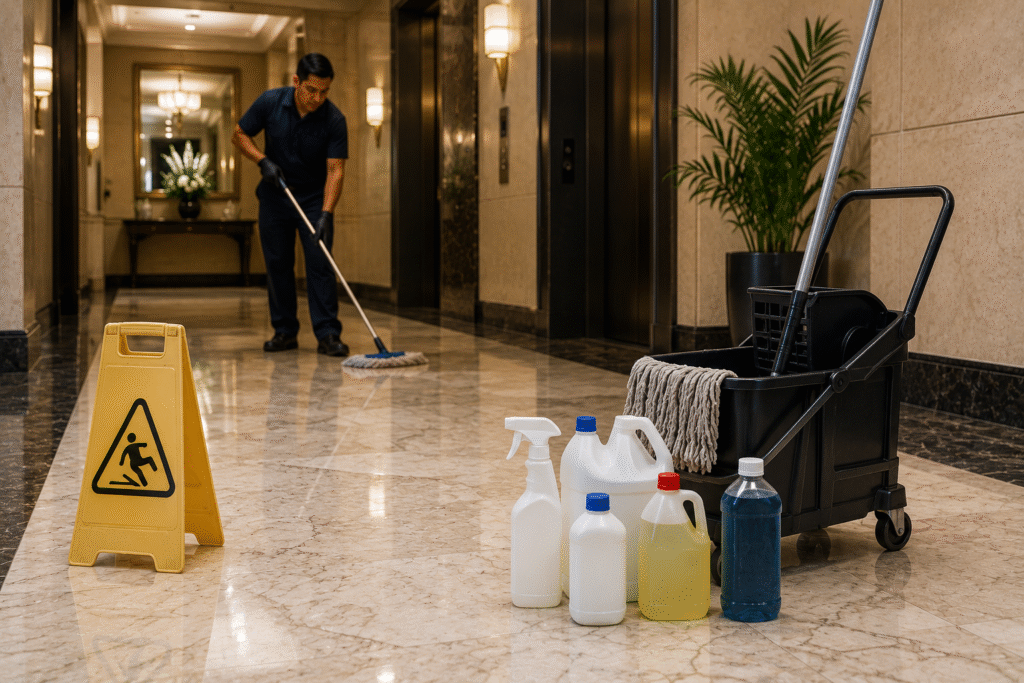
It is one of the most common — and most preventable — sources of stone damage in New York City buildings. A building switches cleaning contractors. The new team shows up Monday morning with their equipment, their products, and their standard procedures. They do what they have always done on every other building they service.
It is one of the most common — and most preventable — sources of stone damage in New York City buildings. A building switches cleaning contractors. The new team shows up Monday morning with their equipment, their products, and their standard procedures. They do what they have always done on every other building they service. And within weeks, sometimes within days, the stone in the lobby starts to look different.
Not better. Different in the way that prompts a building manager to walk over and crouch down for a closer look. Different in the way that generates the first resident complaint. Different in a way that, once the cause is identified, turns out to be entirely avoidable.
Cleaning contractor transitions are one of the leading causes of stone damage in NYC residential and commercial buildings. The new crew is not careless or incompetent — they are simply using products and methods that work perfectly well on other surfaces and are genuinely harmful to natural stone. Without explicit guidance from the building, they have no reason to do anything differently.
This article explains exactly what happens, how to recognize it, what to do when it occurs, and — most importantly — how to prevent it from happening in the first place.
Why Cleaning Contractor Changes Lead to Stone Damage
The root cause is a knowledge gap, not negligence. Most commercial cleaning companies are trained to service a wide variety of surfaces: tile, vinyl, concrete, laminate, carpet, and stone. The products and methods appropriate for ceramic tile — the most common commercial floor surface in NYC — are frequently inappropriate for natural stone, and cleaning crews who spend most of their time on tile bring tile habits to buildings with marble, limestone, granite, or travertine floors.
The previous cleaning contractor, even if they weren’t experts in stone care, had likely developed habits around your building’s specific surfaces over time. They knew which product the building manager had approved. They had been told, at some point, not to use the acidic bathroom cleaner on the lobby floor. They had learned — through experience or instruction — what to avoid. That institutional knowledge does not transfer with the contract.
The new contractor arrives without it. They assess the lobby, identify it as a hard floor surface requiring periodic mopping and maintenance, and apply their standard procedure. If that procedure involves an acidic all-purpose cleaner, they will etch the limestone or marble within the first few cleaning cycles. If it involves an abrasive scrubbing pad on a floor machine, they will scratch the polished surface across the entire lobby in a single visit.
The damage is often not immediately obvious — stone damage from cleaning errors tends to accumulate over weeks and months, becoming apparent only after several cleaning cycles. By the time it’s visible, the contractor may have applied the damaging product dozens of times.
The Most Common Mistakes New Cleaning Crews Make on Natural Stone
Understanding the specific errors most likely to occur during a contractor transition helps building managers identify the cause of damage when they see it — and helps them brief new contractors to prevent it from happening.
Using acidic cleaners on acid-sensitive stone Marble, limestone, and travertine are all composed primarily of calcium carbonate, which reacts chemically with acids. Any cleaner with a pH below neutral — and many commercial all-purpose cleaners, bathroom cleaners, tile descalers, and grout cleaners fall into this category — will etch these stone types on contact. The etching appears as dull, matte, or white spots where the cleaner has dissolved the stone’s polished surface layer. This damage cannot be cleaned away; it requires professional re-polishing to correct.
Using alkaline cleaners at incorrect dilutions Highly alkaline cleaners strip stone sealers, open the stone’s pores, and over time can cause surface damage and discoloration. Many commercial degreasers and heavy-duty floor cleaners are strongly alkaline. Used at the concentrations appropriate for concrete or commercial tile, they are damaging to natural stone.
Applying floor machine scrubbing pads to polished stone Floor machines are standard equipment in commercial cleaning operations and are entirely appropriate for many surfaces. On polished marble, limestone, or granite, an aggressive scrubbing pad — even one described as “soft” for standard floors — can scratch the polished surface across the entire floor in a single pass. The scratches from floor machine pads produce a characteristic hazy or streaky pattern that is distinct from the differential wear caused by foot traffic.
Using steam mops Steam mops are increasingly common in commercial cleaning because of their effectiveness on tile and their perceived “chemical-free” appeal. On natural stone — particularly marble and limestone — the concentrated heat and moisture combination penetrates the stone’s pores, can cause micro-fracturing at the surface layer, and drives moisture into grout lines and sub-surface areas where it promotes discoloration and long-term damage.
Leaving wet residue on the floor Mopping with excessive water — or failing to dry the floor after wet cleaning — leaves standing moisture on stone that penetrates pores, creates watermarks, and over time causes efflorescence (white mineral deposits) and sub-surface staining. The problem is compounded when the mop water is contaminated with cleaning product residue that continues to react with the stone as the moisture evaporates.
Using wax or film-forming products Some cleaning crews use wax-based floor finishes or spray-on shine products on stone floors to create a temporary high-gloss appearance. These products create a film on the stone’s surface that collects dirt, yellows over time, and must be professionally stripped before any legitimate stone maintenance can be performed. Stripping wax from stone is an added cost that would not exist without the inappropriate application.
How to Spot Damage Early: The Signs to Watch For
The sooner cleaning-related stone damage is identified, the less expensive and disruptive the correction will be. Building managers who conduct regular stone condition walkthroughs — ideally within the first month of any new cleaning contractor’s tenure — can catch damage before it becomes significant.
Cloudiness or haziness in the surface, especially in areas of high cleaning frequency If the stone looked clearer and more reflective before the contractor change and now appears cloudy even immediately after cleaning, etching or abrasion from cleaning products is the most likely cause.
Dull, flat spots that don’t respond to cleaning Etch marks from acidic cleaners create areas of localized dullness that are present even on a freshly cleaned surface. These spots are in the stone, not on it, and they will not respond to any cleaning intervention — only professional re-polishing can remove them.
Uniform scratching across large areas rather than traffic-pattern scratching Traffic-related scratching concentrates in the main foot traffic path and develops gradually over time. Scratching from floor machine pads appears more uniformly distributed across the floor area and can develop very quickly. If scratches appear after a cleaning visit rather than gradually over weeks of foot traffic, floor machine damage is likely.
White or chalky streaking after mopping This can indicate cleaning product residue being left on the surface, or the beginning of efflorescence from moisture penetration. Either way, it warrants investigation before the next cleaning cycle occurs.
Darkening or discoloration near grout lines Moisture damage and cleaning product infiltration into grout lines often appears as darkening or discoloration that runs along the joint lines rather than in isolated spots. This pattern, developing soon after a contractor change, suggests moisture is being driven into the stone and grout system.
If you are observing any of these signs following a contractor transition, stopping the current cleaning protocol and contacting a professional stone care company for an assessment is the right immediate response. Continuing with the damaging protocol while the assessment is scheduled will extend the damage and increase the correction cost.
Think Your Stone May Have Been Damaged by Cleaning Products?
Stone Guys NY provides professional damage assessments for NYC buildings following cleaning contractor transitions or product-related incidents. We identify the cause, assess the extent, and recommend the most efficient correction.
Request a Stone Damage Assessment →
What to Do Immediately If You Suspect Cleaning-Related Damage
Speed matters when cleaning-related stone damage is identified. The protocol for an immediate response:
Stop the current cleaning process. Do not allow the cleaning contractor to continue using the product or method that caused the damage while you investigate. The damage is cumulative — every additional application of the wrong product deepens the etch or extends the scratch pattern.
Document the current condition. Take photographs of the affected areas under consistent lighting. This documentation establishes the damage baseline before any correction work begins and may be relevant if there is a contractual dispute with the cleaning contractor.
Identify the products being used. Ask the cleaning contractor for the specific products they have used on the stone surfaces, including brand names and product data sheets. The pH of the cleaning product is the most critical piece of information — anything below 7 on a calcium carbonate stone is the likely cause of any etching damage.
Contact a professional stone care company for an assessment. A trained stone technician can examine the surface, identify the damage type and likely cause, assess the extent, and recommend the appropriate correction. This assessment should happen before any corrective work begins — a diagnosis before treatment.
Determine the cleaning contractor’s liability. If the contractor used products that caused documented damage to the building’s stone, there may be a contractual basis for recovery of the correction cost. Review the service agreement and, if warranted, raise the issue with the contractor formally. This conversation is more productive when you have professional documentation of the damage and its likely cause.
How Professional Stone Technicians Assess and Reverse Cleaning Damage
The good news about most cleaning-related stone damage is that it is correctable. The etch marks, scratches, hazy surfaces, and chemical residue left by improper cleaning products can be addressed professionally — often to a result that is indistinguishable from or better than the original condition.
The correction process depends on the damage type:
Etch mark removal requires mechanical re-polishing to remove the damaged surface layer and restore the stone’s reflective finish. The depth of the etch determines whether polishing alone is sufficient or whether honing — a more aggressive process — is needed first. Our marble restoration services address etch damage across a range of severity levels, from surface-level polishing to full restoration for deeply etched floors.
Scratch removal also requires mechanical re-polishing. For floor machine scratches distributed across a large area, a full-floor re-polish is typically the most efficient approach. Spot treatment of isolated scratches is sometimes possible but often produces visible inconsistency against an unpolished background.
Wax and film removal requires professional stripping using stone-safe stripping agents before any polishing or sealing work can begin. The stripping process must be thorough — residual wax interferes with both polishing abrasives and sealer penetration, producing poor results if not fully removed.
Moisture damage and efflorescence may require both surface treatment and investigation of the underlying moisture source. Surface efflorescence can often be removed professionally; recurring efflorescence suggests ongoing moisture infiltration that needs to be addressed structurally.
After any corrective work, re-sealing with an appropriate penetrating sealer is essential to protect the restored surface. Buildings whose stone has been damaged by improper cleaning were almost certainly not being re-sealed on an appropriate schedule — the sealer would have provided some buffer against cleaning product penetration. Re-establishing a proper sealing schedule is part of the corrective program, not an afterthought.
Preventive Steps: Briefing New Contractors and Setting Product Standards
Prevention is categorically less expensive than correction. The steps a building manager takes when onboarding a new cleaning contractor determine whether the contractor transition becomes a stone damage event or a seamless handoff.
Conduct a stone orientation before the first cleaning day. Walk the new contractor through the building’s stone surfaces. Identify each stone type. Explain its specific sensitivities. Show the contractor the approved products and demonstrate the correct mop wetness, the dry mopping protocol after wet cleaning, and the spill response procedure.
Provide a written product specification. List every approved cleaning product by brand name and specify the correct dilution ratio. Include an explicit prohibition on any product not on the approved list being used on stone surfaces without prior written approval from building management. This document protects both the building and the contractor by establishing clear standards.
Require product data sheets before use. Any product a contractor wants to use on stone should come with a product data sheet that includes pH information. Review it before approving use. If the pH is below 6.5 or the product description doesn’t confirm stone-safe formulation, do not approve it.
Schedule a 30-day follow-up inspection. After the first month of a new contractor’s service, have a stone professional or a knowledgeable building manager conduct a focused condition inspection of the stone surfaces. Catching any developing issues at 30 days is far less costly than discovering them at six months.
Introduce the new contractor to your stone care provider. If your building has an ongoing relationship with a stone restoration or maintenance company, introducing the cleaning contractor to that provider creates a communication channel that benefits both parties. The stone care company can advise the cleaning contractor on product selection and method; the cleaning contractor can flag any observed stone conditions to the stone care company between scheduled service visits.
For buildings that don’t yet have a formal relationship with a stone care provider, our article on stone care contracts for NYC buildings covers how to structure that relationship and what to look for in a qualified provider.
It’s also worth reviewing the specific maintenance needs of your building’s primary stone type. Our guides on limestone lobby maintenance and marble lobby maintenance provide the stone-specific protocols that should inform both your cleaning contractor briefing and your professional service program.
Don’t Let a Contractor Change Become a Stone Damage Event
Stone Guys NY helps NYC building managers navigate cleaning contractor transitions with pre-transition assessments, product specification guidance, and post-transition inspections that catch any emerging issues before they become expensive problems.
Contact Stone Guys NY to Protect Your Building’s Stone During a Contractor Transition →
Stone Guys NY provides professional marble, granite, limestone, terrazzo, travertine, and natural stone restoration and maintenance for commercial buildings, residential properties, and hotels across New York City. Call us at (888) 786-6369 or email info@StoneGuysNY.com.