
- By Escala SEO
- In Blog
Bluestone Patio Sealing: When and Why It Matters
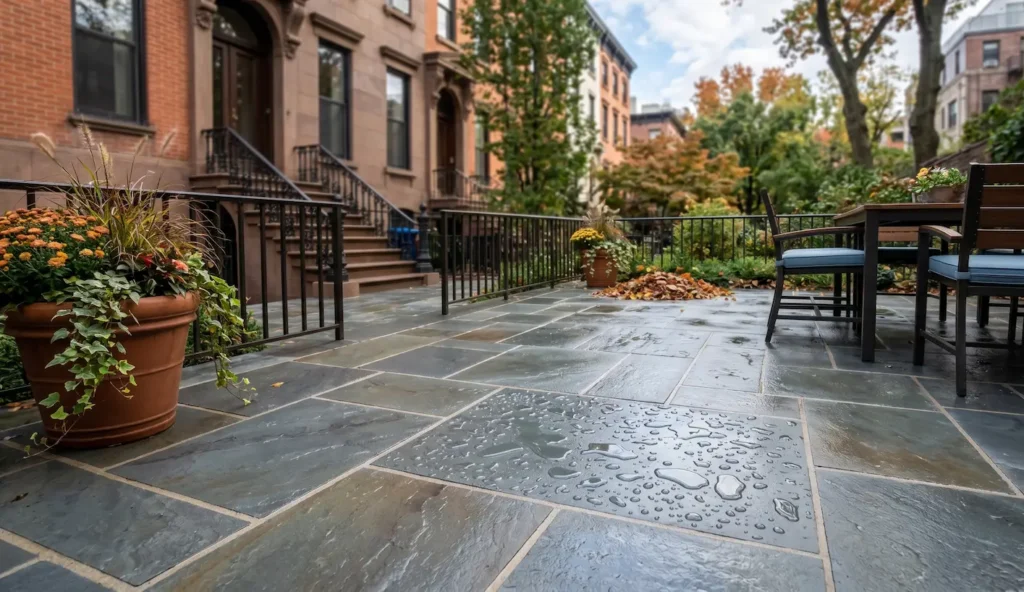
Every fall, New York City homeowners notice the same thing: after a summer of cookouts, foot traffic, and afternoon rain showers, the bluestone patio that looked clean and even in spring has taken on a different character. There are dark moisture patches that linger for days. Leaf stains have left brown outlines where foliage sat over the weekend. A section near the downspout looks faded and patchy compared to the rest. And winter has not even started yet.
This is not unusual — it is the predictable result of unprotected bluestone in an urban environment where weather, organic debris, salt, and daily use put constant pressure on outdoor stone. The good news is that most of these issues are preventable, or at least significantly reducible, with proper sealing and maintenance.
Bluestone is one of the most popular outdoor stone materials in New York City, valued for its durability, natural color range, and compatibility with the brownstone townhouse architecture that defines so many NYC neighborhoods. But durable does not mean maintenance-free. Understanding when and why to seal bluestone — and what happens when you don’t — is the foundation of keeping outdoor stone surfaces looking their best for years to come.
What Is Bluestone Used For in NYC Homes?
Bluestone appears throughout New York City’s residential and commercial landscape, often in places that receive some of the heaviest use and harshest weather exposure on a property:
- Front stoops and entry steps — among the most high-traffic surfaces on any NYC brownstone or townhouse, exposed to rain, snow, salt, and foot traffic year-round
- Walkways and garden paths — connecting entry points and outdoor living areas, subject to moisture from the ground below as well as precipitation from above
- Patios and terraces — outdoor entertaining and living areas on ground floors, rooftops, and rear gardens, exposed to full weather and regular use
- Entryway landings — flat areas at building entrances that collect tracked-in material and are cleaned frequently with whatever products the cleaning staff has on hand
- Courtyard paving — in multi-unit buildings and brownstone conversions, shared outdoor areas paved with bluestone require coordinated maintenance across the whole surface
Each of these applications shares a common characteristic: the stone is outdoors, often horizontal, and fully exposed to the elements. That combination of exposure makes regular sealing not just beneficial, but a practical necessity for maintaining both appearance and longevity.
Why Bluestone Patios Need Sealing
Bluestone is a type of sandstone or dense sedimentary rock, and while it is harder and denser than many natural stones, it is still porous — capable of absorbing water, staining agents, and organic material if left unprotected. In New York City’s climate, that porosity creates specific vulnerabilities that sealing directly addresses.
Resists staining from organic and environmental sources Leaves, berries, bird droppings, food and beverage spills, rust from metal furniture, and soil runoff all contain pigments or compounds that can stain porous bluestone. A properly applied penetrating sealer slows absorption, giving you more time to clean up spills and residue before they penetrate the stone.
Reduces moisture absorption Water that absorbs into bluestone carries dissolved minerals that can deposit inside the stone as the water evaporates — contributing to efflorescence and salt damage over time. Reducing moisture absorption also reduces the speed at which the stone experiences freeze-thaw cycles in winter.
Eases routine cleaning Sealed bluestone surfaces release dirt, algae, and grime more readily than unsealed stone. For property managers and homeowners who clean outdoor areas regularly, sealed surfaces require less effort and fewer aggressive cleaning products to maintain.
Preserves color and appearance Unsealed bluestone in sun and rain exposure gradually fades, taking on a patchy, inconsistent appearance as different areas absorb moisture and staining agents at different rates. Sealing helps the stone maintain a more uniform appearance over time.
Supports long-term maintenance efficiency Regular sealing extends the time between professional restoration cycles, which means lower long-term maintenance costs. A sealed surface that is cleaned annually requires far less corrective work than an unsealed surface left unattended for several years.
Signs Your Bluestone Patio Needs Sealing
The simplest test for sealer condition is also the most telling: pour a small amount of water on the surface and watch what happens. If the water beads up and rolls off, the sealer is working. If it absorbs into the stone within a minute or two — darkening the surface — the sealer has failed or was never applied, and the stone is unprotected.
Beyond the water test, these are the signs to look for:
- Water no longer beads on the surface — the most direct indicator of sealer failure
- Faded or patchy color — areas of the stone look lighter, washed-out, or inconsistent compared to others
- Staining from leaves, berries, rust, or food that has penetrated the surface and resists cleaning
- White powdery residue (efflorescence) appearing on the surface, indicating that moisture is moving through the stone and depositing minerals at the surface as it evaporates
- Persistent dark moisture spots that take several days to dry after rain
- Algae or green biological growth beginning to establish on the surface, particularly in shaded or damp areas
- Surface feels rough or harder to clean than it used to — a sign that the stone has been absorbing contaminants and the surface texture has changed
If multiple signs are present, the stone likely needs both professional cleaning and resealing — not sealing alone.
What Happens If Bluestone Is Not Sealed?
Left unprotected in a New York City environment, bluestone patios and walkways are subject to a predictable progression of deterioration:
Moisture absorbed into the stone during rain and snowmelt carries dissolved salts and minerals. As that moisture evaporates — or freezes — it can deposit minerals within the stone’s pores or exert pressure against the stone structure from inside. Over time, repeated freeze-thaw cycles weaken the stone, contributing to surface spalling, flaking, and in severe cases, cracking.
Organic material — leaves, debris, soil — sits on unprotected bluestone and gradually stains it. Rust from metal outdoor furniture and planters leaves particularly stubborn marks. Bird droppings are acidic and can etch the surface. All of these contaminants absorb more readily and more deeply into unsealed stone, making them increasingly difficult to remove over time.
The cumulative result of years without sealing is a surface that looks older, dirtier, and more worn than its actual age — and one that requires significantly more corrective work to restore. The cost and effort of restoration after years of neglect almost always exceeds what consistent sealing and maintenance would have cost over the same period.
For a detailed look at what NYC winters specifically do to outdoor stone, Stone Guys NY’s guide on post-snow melt outdoor stone care and freeze-thaw damage prevention is a practical resource for any outdoor stone owner.
Bluestone Cleaning Before Sealing
One of the most important principles in professional stone sealing is this: sealing is never the first step. It is always the last.
Applying sealer over bluestone that has algae, embedded staining, leaf residue, efflorescence, or previous sealer failure locks those problems in beneath the new sealer layer. The stone may look temporarily better, but the underlying issues continue to develop beneath the surface — and the new sealer will fail faster because of the compromised substrate it was applied over.
Professional cleaning before sealing typically involves:
- Removing loose debris and surface contamination
- Deep cleaning with alkaline stone-safe products to break down organic residue, soap deposits, and biological growth
- Targeted stain treatment for rust, leaf tannins, or other specific staining agents
- Rinsing and allowing the stone to dry thoroughly before sealer application — moisture in the stone can prevent proper sealer penetration and adhesion
The cleaning process may reveal additional issues — cracked joints, deteriorated mortar, surface damage, or areas that need repair — that should be addressed before sealing. Sealing over structural problems does not resolve them.
Types of Bluestone Sealers
Not all sealers are appropriate for all applications, and choosing the right product for an outdoor bluestone surface matters for both performance and appearance.
Natural-look penetrating sealers These are the most commonly recommended option for outdoor bluestone. They penetrate into the stone’s pores and create a protective barrier without altering the surface appearance — the stone looks the same as it did before sealing, just protected. They do not create a film on the surface, which means they do not peel, flake, or become slippery when wet. This is the standard choice for most NYC patios, stoops, and walkways.
Color-enhancing penetrating sealers These work similarly to natural-look sealers but deepen the color of the stone, bringing out the natural blues, greens, and grays in the bluestone. They create a wet-look effect without a high-gloss shine. Appropriate when the homeowner wants to enrich the stone’s color as part of the maintenance process.
Topical or film-forming sealers These sit on top of the stone surface rather than penetrating into it, creating a coating layer. They are generally not recommended for outdoor horizontal surfaces like patios and walkways, where they are subject to wear from foot traffic and exposure — they tend to peel, flake, and trap moisture beneath the film over time. A professional assessment should precede any decision to use a topical sealer outdoors.
Best Time to Seal Bluestone in NYC
Timing matters for sealer application. In New York City’s climate, the practical windows for outdoor stone sealing are:
Spring (April–June) — After winter has passed and the stone has dried thoroughly from snowmelt and spring rain. This is often the ideal time, as it prepares the stone for heavy summer use and gives the sealer time to cure in mild temperatures before the heat of summer.
Early fall (September–October) — Before temperatures drop and before the first winter precipitation. Sealing in early fall protects the stone through the most damaging season of the year — winter — when freeze-thaw cycles and salt pose the greatest threat to unprotected stone.
Sealer should not be applied when surface or air temperatures are below 50°F, when rain is expected within 24–48 hours of application, or when the stone contains residual moisture from recent precipitation. A professional team will assess conditions before proceeding and will not seal if conditions are not right — doing so would compromise the sealer’s performance and longevity.
Professional Bluestone Sealing vs. DIY
Consumer-grade bluestone sealers are available at hardware stores, and some homeowners choose to apply them as a DIY project. For light maintenance on a clean, previously sealed surface in good condition, this can be adequate. But there are important situations where professional assessment and application make a significant difference:
- When the stone has not been sealed in several years and the condition of the substrate is unknown
- When there are visible stains, efflorescence, algae, or biological growth that need to be addressed before sealing
- When previous sealer has failed unevenly and residue needs to be removed before new sealer can properly penetrate
- When cracks, damaged joints, or surface repairs are needed alongside sealing
- When multiple surfaces are involved — patios, steps, walkways, and stoops may require slightly different products or application approaches
A professional team will assess moisture levels in the stone before sealing, select the appropriate product for the stone type and application, apply the sealer evenly at the correct coverage rate, and confirm that conditions are right for proper curing.
Stone Guys NY’s bluestone restoration services include pre-sealing inspection, cleaning, and professional sealer application as part of a complete outdoor stone maintenance program.
Maintenance Tips After Sealing Bluestone
Professional sealing protects bluestone — but it does not eliminate the need for regular care. After sealing, maintaining the protection requires consistent habits:
- Sweep or blow off debris regularly — leaves and organic material sitting on the surface will eventually stain even sealed stone if left long enough; frequent removal is the simplest preventive step
- Remove leaves promptly — particularly in fall, when tannic acid from decomposing leaves can leave stains even on sealed surfaces
- Rinse salt residue after winter weather — rock salt and de-icing products, while sometimes necessary for safety, are corrosive to stone sealers and should be rinsed off as soon as conditions permit
- Avoid harsh chemical deicers when possible — sand or stone-safe ice melt products are less damaging alternatives for areas where traction is needed
- Use pH-neutral cleaners for routine washing; avoid pressure washing at high PSI, which can strip sealer and erode the stone surface
- Schedule a post-winter inspection each spring to assess sealer condition and address any damage before the warmer months of heavy use
For a full guide to bluestone restoration and long-term outdoor stone care in NYC, Stone Guys NY’s resource covers the complete picture of what bluestone surfaces need through every season.
Frequently Asked Questions About Bluestone Patio Sealing
How often should bluestone be sealed? For most NYC outdoor applications, resealing every two to three years is a reasonable baseline. Surfaces in higher-exposure situations — heavy foot traffic, full sun and weather exposure, proximity to trees — may benefit from more frequent resealing. The water bead test is the easiest way to check whether sealer is still performing between scheduled maintenance.
Does sealing make bluestone slippery? Penetrating sealers, which are the standard recommendation for outdoor horizontal surfaces, do not create a film on the stone and do not increase slipperiness when wet. Topical or film-forming sealers can reduce traction, which is one of the reasons they are generally not recommended for exterior patios, steps, and walkways.
Can sealing restore faded bluestone color? A natural-look penetrating sealer will not significantly change the color of faded bluestone — it preserves the current state rather than restoring color. A color-enhancing sealer can deepen and enrich the stone’s natural tones, which can make faded stone look more vibrant. For stone that has lost significant color due to years of weathering and staining, professional cleaning and restoration before sealing may produce a more noticeable improvement.
Should bluestone be cleaned before sealing? Always. Applying sealer over dirty, stained, or algae-covered stone locks in those problems and compromises sealer adhesion and longevity. Professional cleaning is a necessary step before any sealing work — not an optional add-on.
Can damaged bluestone be restored before sealing? Yes, and it should be. Cracks, spalling, deteriorated mortar joints, or surface damage should be repaired before sealing is applied. Sealing over damage does not repair it, and can actually make future repairs more complicated by sealing contaminants or moisture into problem areas. A professional assessment will identify what repairs are needed before the sealing process begins.
Protect Your Bluestone Patio, Stoop, or Walkway
NYC weather is relentless — but its impact on bluestone outdoor surfaces is manageable with the right maintenance approach. Regular professional sealing, combined with proper cleaning and consistent post-sealing care, is the most cost-effective way to keep patios, stoops, steps, and walkways looking clean, even, and well-maintained year after year.
Ready to protect your outdoor stone? Contact Stone Guys NY for professional bluestone cleaning and sealing services throughout Manhattan, Brooklyn, Queens, the Bronx, and surrounding areas. We work with homeowners, landlords, and property managers to assess, clean, restore, and seal outdoor stone surfaces — with the local knowledge and expertise that NYC properties require.


LEAVE A COMMENT