
- By stoneguysny
- In Blog
Countertop Chip Repair and Crack Reconstruction in NYC: When Damaged Stone Can Be Saved
A chipped quartz edge, fractured granite section, or broken sink rail does not always require full countertop replacement. Learn how professional chip repair and crack reconstruction address four real types of stone damage.
A dropped bottle can knock a neat half-moon from a countertop edge. A crack beside a sink may begin as a thin line, then loosen an entire section of stone. When material is visibly missing, many homeowners assume replacing the whole countertop is the only responsible option.
Often, it is not.
Professional countertop chip repair can rebuild a small damaged quartz edge, while crack reconstruction can address larger fractures, missing granite sections, and failed areas around sinks or fixtures. The correct repair depends on more than the size of the opening. A stone specialist must consider the material, location, support, movement, moisture exposure, finish, and cause of failure before recommending a solution.
Stone Guys NY repairs natural and engineered-stone surfaces throughout New York City and the surrounding area. The goal is not to cover damage with a quick patch. It is to restore usable geometry, improve the appearance, and make the repaired area as stable and discreet as the existing condition allows.
Chip Repair and Crack Reconstruction Are Not the Same Service
A chip is a localized loss of material, usually caused by impact at an exposed edge or corner. If the surrounding countertop remains solid, the missing area may be rebuilt with repair materials adjusted for color, depth, and translucency.
A crack is a separation within the slab. It may be limited to the surface, extend through the full thickness, or continue beyond the portion that can be seen. A crack near a sink, cooktop, seam, or overhang can also indicate stress or inadequate support.
A reconstruction is more involved. It may be necessary when an edge profile has broken away, a sink rail has lost a substantial section, or a fracture has left an irregular void. Reconstruction requires the technician to recreate both the missing mass and the original shape—not merely fill a line.
That distinction matters. Treating structural movement as a cosmetic chip can leave the underlying cause unaddressed.
Four Real Countertop Repair Challenges
These four projects show how widely countertop damage can vary—from small quartz chips to major granite edge failure.
1. Localized Chip on an Off-White Quartz Edge


The first project began with a rounded chip on the front edge of an off-white quartz countertop. This is a classic impact location: the exposed edge can be struck by cookware, bottles, small appliances, or items being moved near a dishwasher.
When the quartz surrounding a chip like this is stable, the repair may involve cleaning and preparing the damaged area, rebuilding the missing section with color-adjusted material, reproducing the edge line, and refining the surface to coordinate with the factory finish. Even a small chip requires careful shaping; an inaccurate radius or edge transition can remain noticeable after the color has been matched.
2. Deeper Chip on a Warm-Toned Caesarstone Quartz Edge


The second project shows missing material where the top surface of a warmer, yellow-toned Caesarstone quartz countertop meets the front face. This transition catches both light and touch, so the repair must align two visible planes. A fill that is too high, too low, too glossy, or too opaque may stand out even when its base color is close.
This type of quartz countertop repair is a precision task. Color is only one part of the match; translucency, aggregate, sheen, and the sharpness or softness of the original edge also affect the result.
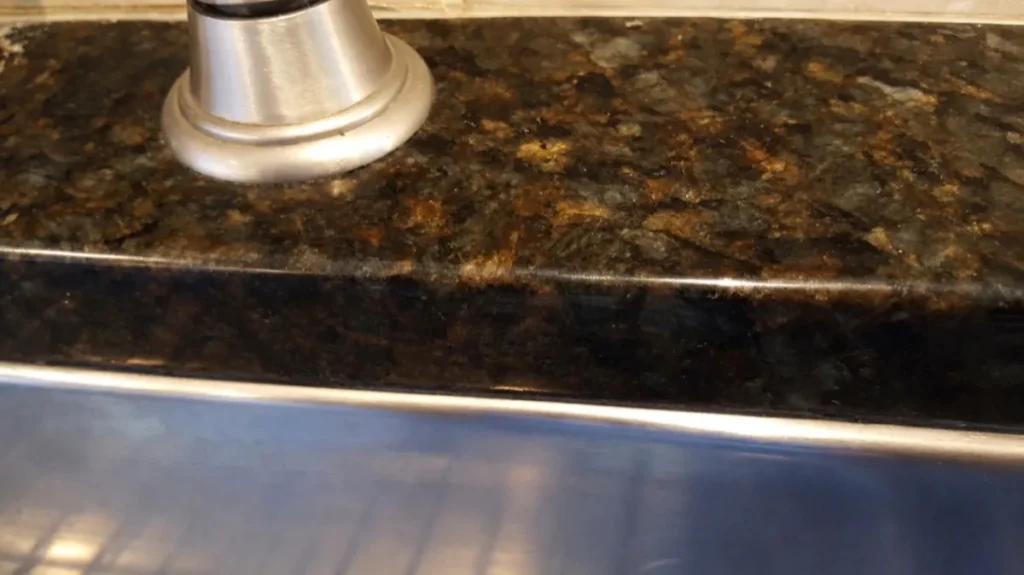
3. Fractured Section in Green Granite Near a Fixture


The third project involved a much larger loss in a patterned green granite surface near a fixture and finished edge. This was no longer a simple pinhole or surface nick. The irregular boundary, exposed stone, and missing mass called for reconstruction.
On patterned granite, a successful repair must work with multiple colors, mineral movement, depth, and reflectivity. The technician may need to build the repair in stages, recreate the edge geometry, and visually break up a solid patch so it belongs within the surrounding pattern. The damaged area should also be checked for continuing fractures or movement before cosmetic work begins.
4. Extensive Granite Failure Along a Sink Cutout


The fourth project shows extensive deterioration and missing granite along a sink edge. Sink cutouts are among the most demanding areas of a countertop because the remaining stone can be narrow, frequently wet, and exposed to impact and movement. The visible damage may be only part of the problem.
Before rebuilding an area like this, a stone repair specialist should determine whether loose material remains, whether the slab is moving, whether the sink or cabinet is properly supported, and whether earlier repair material or prolonged contamination affects adhesion. Reconstructing the visible edge without addressing instability can leave a vulnerable repair.
Why Countertops Chip and Crack Around Edges and Sinks
Quartz and granite countertops are durable, but durability does not make every part of a slab equally resistant. Damage often appears at stress points rather than in the open field of the countertop.
Common contributing conditions include:
- Direct impact from cookware, bottles, tools, or small appliances.
- Thin or exposed front edges and outside corners.
- Narrow sections of stone in front of or behind a sink or cooktop.
- Insufficient cabinet, substrate, or overhang support.
- Movement at a seam or between cabinets.
- Stress concentrated at a cutout or inside corner.
- Existing fissures, voids, or weak mineral areas in granite.
- Heat-related stress or damage in some engineered quartz surfaces.
- Failed or contaminated previous repairs.
Not every chip signals a structural problem. Conversely, not every narrow crack is merely cosmetic. The location and behavior of the damage matter as much as its width.
What Professional Countertop Repair May Include
1. Diagnose the Damage
The technician identifies the surface, examines the fracture path, checks for loose material, and looks for movement or inadequate support. The original broken fragment, if available, is also evaluated.
2. Prepare and Stabilize the Area
Loose, weak, or contaminated material must be addressed so the repair bonds to a sound surface. If the crack is active or the surrounding slab lacks support, stabilization may be required before appearance can be considered.
3. Rebuild the Missing Material
Professional repair compounds are selected and adjusted to suit the countertop’s color and visual depth. Larger reconstructions may require layered placement rather than a single surface fill.
4. Recreate the Profile and Finish
The repaired section is shaped to continue the countertop’s original plane, corner, radius, bevel, or other edge profile. It is then refined to coordinate with the surrounding finish.
5. Inspect the Result and Explain Its Limits
The final area should be examined from normal viewing positions and under different light angles. A responsible specialist explains what has been restored, what may remain perceptible, and how to avoid renewed impact or stress.
Quartz Repair and Granite Reconstruction Require Different Judgment
Quartz and other engineered stones contain mineral aggregate, pigments, and resin. Their factory finish, consistent field color, and sometimes translucent appearance can make local repairs especially sensitive to differences in sheen, tint, and depth.
Granite contains natural mineral variation. That movement can help disguise a carefully composed repair, but reflective crystals, deep colors, and irregular fracture paths require experience to reproduce convincingly. Larger granite failures may also require careful evaluation of fissures and support before reconstruction begins.
There is no universal filler or finishing method for every countertop. This is why a repair kit chosen only by the words “white,” “black,” or “granite” rarely produces a professional result.
Will a Chip or Crack Repair Be Invisible?
Sometimes a well-executed repair becomes difficult to find from normal standing distance. It is still unwise to promise that every repair will be invisible.
Visibility depends on the color and pattern, amount of missing material, location, original finish, lighting, contamination, and whether the slab remains under stress. Solid light quartz colors may reveal a slight tint or translucency difference. Bold granite movement may be difficult to continue precisely. Side lighting can show a transition that overhead lighting does not.
For a more detailed explanation, read Will a Quartz Countertop Repair Line Be Visible?
When Repair Makes Sense—and When Replacement May Be Better
Repair is often worth considering when:
- The damage is localized.
- The surrounding countertop remains stable.
- The missing profile can be reconstructed.
- The customer wants to avoid the cost, disruption, and material-matching problems of replacement.
- A substantial visual improvement is acceptable even if close inspection may reveal the repair.
Replacement or fabrication consultation may be the better recommendation when:
- A crack continues to move or spread.
- Cabinets, substrate, or sink support are unstable and cannot be corrected within the repair scope.
- A large portion of the slab has failed.
- Widespread heat or chemical damage has changed the material.
- Previous adhesives or contamination prevent a reliable bond.
- The required standard is a factory-perfect surface with no possibility of a visible repair line.
An honest assessment separates what can technically be filled from what can be repaired to a standard that meets the customer’s functional and visual expectations.
What to Do When Your Countertop Breaks
- Save every original fragment, even if it looks small or irregular.
- Keep the damaged area dry and avoid placing weight on it.
- Do not apply household glue, caulk, marker, or a do-it-yourself filler before the assessment.
- Take one wide photo of each damaged section.
- Take one focused close-up of the worst area, chip, or crack.
Good photographs help determine whether the likely scope is cosmetic quartz chip repair, granite edge reconstruction, crack stabilization, sink-area repair, or replacement consultation.
Countertop Chip and Crack Repair in New York City
With more than 30 years of combined hands-on experience, Stone Guys NY restores natural and engineered-stone surfaces for homeowners, property managers, designers, contractors, and commercial facilities. Our in-house team handles localized chips, broken edges, cracks, seams, missing sections, and other repair challenges with the care each material and condition requires.
If your quartz, Caesarstone, granite, marble, quartzite, or other stone countertop is chipped or cracked, send clear photographs for an initial assessment. Call or text (888) 786-6369 or email info@StoneGuysNY.com to discuss countertop repair in NYC and the surrounding area.
Frequently Asked Questions
Can a chipped quartz countertop be repaired?
Many localized quartz chips can be rebuilt without replacing the entire countertop. The result depends on the chip’s depth, location, color, pattern, finish, and whether the surrounding material is stable.
Can a cracked granite countertop be repaired?
Many granite cracks can be filled, stabilized, or reconstructed, but the cause must be evaluated first. Cracks caused by movement or inadequate support may need more than cosmetic filling.
Can a broken granite edge around a sink be reconstructed?
Often, yes. Sink-edge repair may involve rebuilding missing material and recreating the profile. If the remaining granite is moving, lacks support, or contains widespread deterioration, additional reinforcement or replacement may be recommended.
Will the repaired area match exactly?
The goal is a discreet, durable repair that coordinates with the surrounding color, pattern, geometry, and finish. Slight variation or a detectable repair line may remain, especially under close inspection or directional lighting.
Should I keep the piece that broke off?
Yes. Keep all fragments clean, dry, and protected. An original piece may help preserve the countertop’s color and pattern, although it cannot always be reused.
What photos should I send for an estimate?
Send one wide photo of each damaged section and one focused close-up of the worst area, chip, or crack. Measurements are not required; clear photographs are more useful for evaluating and pricing this type of repair.