
- By Escala SEO
- In Blog
Granite Surfaces in Commercial Lobbies: Durability Doesn’t Mean Maintenance-Free
Ask almost anyone why they chose granite for their building’s lobby and the answer will include some version of the word “durable.” Granite is hard. Granite is tough. Granite holds up. And compared to marble or limestone, all of that is true — granite is one of the most physically resilient natural stones available, and that resilience is a legitimate reason why it appears so frequently in commercial lobbies, reception desks, elevator surrounds, and wall cladding across New York City.
But durability is not the same as invincibility. And the belief that granite is essentially maintenance-free — a belief that is remarkably widespread among building owners and facilities managers — is one of the most expensive misconceptions in commercial property management.
Granite that goes without professional care for years does not stay looking the way it looked on installation day. It dulls. It scratches. It stains. And by the time the damage is obvious enough to prompt action, correcting it costs significantly more than consistent maintenance would have.
This article is for building owners and commercial property managers who want an honest picture of what granite actually needs in a commercial environment — and why the “set it and forget it” approach to granite maintenance ultimately costs more than it saves.
The Myth of Maintenance-Free Granite
The myth of maintenance-free granite has two sources. The first is the comparison to marble. Granite is genuinely more resistant to etching, scratching, and staining than marble — and anyone who has managed both surfaces in commercial buildings will confirm that. Granite is harder, denser, and less reactive to acidic substances. That comparison created a perception of near-indestructibility that the stone simply doesn’t deserve.
The second source is the sales environment. Granite has been marketed to homeowners and commercial buyers for decades as a low-maintenance premium surface. That message served the sales process well. It did not serve the buildings that installed it.
Here is the reality: granite in a commercial lobby is not a residential countertop. The conditions are categorically different. A kitchen countertop might support a few meals a day and get wiped down with a cloth. A commercial lobby floor or reception desk surface faces hundreds of contact events daily — foot traffic, cleaning equipment, delivery carts, briefcases, keys, and two decades of New York City winters being tracked in on the soles of shoes.
Under those conditions, granite requires professional care. Not as often as marble, and not with the same urgency — but regularly, deliberately, and with products and techniques appropriate for the material.
How Commercial Traffic Affects Granite Differently
The physics of stone surface wear are the same regardless of material: harder particles scratch softer ones. Granite is harder than marble, which is why it scratches less easily. But granite is not harder than quartz, sand, or the industrial-grade grit that gets embedded in shoe soles and tracked across commercial floors every day.
Over time, that grit acts as sandpaper on granite surfaces. The effect is most visible in the areas of highest foot traffic — typically the path from the building entrance to the elevator banks, the area immediately in front of a reception desk, and any corridor that connects a parking garage or loading dock to the main lobby. In these zones, the granite gradually loses its polished surface and takes on a dull, hazy appearance that no amount of cleaning will reverse.
This is not a sign that the granite is damaged. It is a sign that the granite needs professional re-polishing — a mechanical process that restores the surface’s crystalline structure and brings back its reflective finish. Polishing granite is different from polishing marble, requiring different abrasive sequences and finishing compounds, which is why it requires a technician with specific granite experience rather than a general stone cleaner.
Reception desk surfaces and countertops face a different set of stressors. They are touched constantly, cleaned aggressively with whatever product the cleaning crew has on hand, and subjected to the full range of substances that pass through a busy commercial building — coffee cups, hand sanitizer, cosmetics, pens, and every type of food and beverage imaginable. Without proper sealing and periodic professional care, even a high-quality granite countertop will show its age in a commercial environment within a few years.
Common Issues Found in Commercial Granite Surfaces
Years of working in commercial buildings across New York City have given our team a clear picture of the damage patterns that granite develops when maintenance is deferred. The issues are consistent and predictable:
Surface dullness in high-traffic pathways The most universal finding. Polished granite in lobby floors develops a visible contrast between low-traffic areas — near walls, under furniture, in corners — and the main traffic pathways. The low-traffic areas retain their original shine; the pathways are visibly duller. This differential wear pattern is the clearest indicator that professional re-polishing is overdue.
Scratching on reception desk and countertop surfaces Granite reception desks in active commercial lobbies accumulate fine scratches over time from keys, metal pens, equipment, and the daily contact of a busy front-of-house operation. When the surface loses its polish in these areas, the scratches scatter light rather than reflecting it, creating a dull, cloudy appearance that makes an otherwise high-quality installation look neglected.
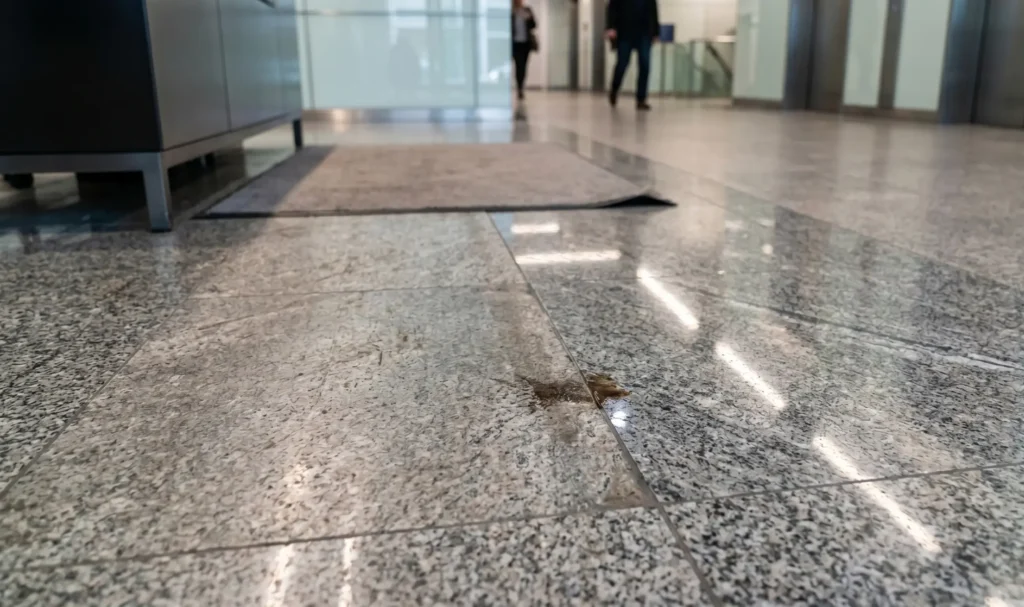
Staining near building entrances and elevator areas Despite its density, granite is not completely non-porous. Unsealed or under-sealed granite in high-contact areas will absorb oils, water, and other substances over time. Staining near entrance mats — where moisture and contaminants concentrate — is a common finding in commercial lobbies where granite sealing has been deferred.
Surface etching on certain granite types Not all granite is equally resistant to chemical etching. Some darker granites and certain imported varieties that are sold as granite are actually closer to marble in their mineralogical composition and can show etch marks from acidic cleaners or spills. If your building’s granite shows white or dull spots that don’t respond to cleaning, chemical etching may be the cause.
Wall cladding discoloration and streaking Granite wall panels in lobbies accumulate dust, fingerprints, and cleaning product residue in ways that are different from floor surfaces. Improper cleaning leaves streaking and film buildup that dulls the stone’s appearance over time. Professional cleaning and re-sealing of wall granite is an often-overlooked part of lobby maintenance.
If any of these issues are visible in your building’s granite surfaces, a professional assessment from Stone Guys NY’s granite restoration team will identify the scope of the problem and the most efficient path to correction.
📋 Does Your Building’s Granite Need Professional Attention?
Surface dullness, scratching, and staining in commercial granite are correctable — but the longer they’re left unaddressed, the more intensive the restoration required. Stone Guys NY offers free commercial property assessments across NYC.
Schedule a Free Granite Assessment for Your Building →
Professional Granite Polishing vs. DIY Products
Walk into any hardware store or search online and you will find dozens of products marketed as granite polishers, granite shine restorers, and granite cleaners. Some of them are harmless. A few of them are genuinely useful for maintaining a surface that is already in good condition. None of them will restore a granite surface that has lost its polish through traffic abrasion or mechanical wear.
The reason is simple: polishing granite — real polishing, the kind that restores a reflective surface — is a mechanical process. It requires diamond abrasives, floor machines with appropriate tooling, and a technician who understands the abrasive sequence needed to take a scratched or dulled surface back to a high gloss finish. A spray-on product cannot replicate this process. What it can do is leave a temporary film that creates the appearance of shine while building up a residue that will require professional stripping before any real restoration can be done.
This is not an argument against all maintenance products. A high-quality granite-specific cleaner used consistently by your cleaning crew, combined with periodic professional re-sealing, is a legitimate part of a good maintenance program. The distinction is between maintenance — keeping a good surface good — and restoration, which is bringing a degraded surface back to its proper condition. Only professional mechanical treatment accomplishes the latter.
For context on how this distinction applies across stone types in commercial buildings, our article on marble floor polishing vs. full marble restoration covers the underlying principles in detail.
How Often Commercial Granite Should Be Professionally Serviced
Service frequency for commercial granite depends on traffic volume, the specific installation, and the current condition of the surface. As a general framework:
High-traffic lobby floors (major commercial buildings, large residential buildings) Professional inspection and cleaning: every 3 to 6 months Re-polishing: every 12 to 18 months depending on wear Re-sealing: every 12 months, or immediately after re-polishing
Moderate-traffic lobby floors (mid-size commercial buildings, boutique hotels) Professional inspection and cleaning: every 6 months Re-polishing: every 18 to 24 months Re-sealing: every 12 to 18 months
Reception desks and countertop surfaces Professional cleaning and inspection: every 6 months Re-polishing and re-sealing: every 12 to 18 months depending on use intensity
These intervals assume that daily cleaning is being performed correctly with appropriate products. If your building’s cleaning contractor is using acidic or abrasive products on granite, or failing to dry the surface after mopping, the damage accumulates faster and professional service will be needed more frequently.
Understanding how to communicate stone care standards to your cleaning contractor — and what specifications to require — is one of the most valuable conversations a facilities manager can have with a professional stone care company. It is also something our team addresses directly as part of any service engagement.
Granite Wall Cladding: The Overlooked Surface
Most of the attention in granite maintenance discussions focuses on floors, and for good reason — floors take the most traffic and show wear most dramatically. But granite wall cladding in commercial lobbies deserves its own maintenance consideration and is frequently overlooked in building maintenance programs.
Granite wall panels accumulate fingerprints, dust, and cleaning product residue continuously. Improper cleaning with streaky or filmy products creates a visual degradation that is most visible under the kind of dramatic lobby lighting that makes beautiful stone look spectacular — and makes poorly maintained stone look worse than it actually is.
Wall granite also benefits from periodic re-sealing, which protects against the oil and moisture transfer from constant hand contact. In high-traffic areas near elevator buttons, directory boards, and entrance doors, unsealed granite wall panels will show dark, oily patches that are difficult to remove once the stone has absorbed them.
A complete lobby granite maintenance program — one that addresses floors, countertops, and wall surfaces together — gives a commercial building a consistency of appearance that a floor-only approach cannot achieve.
For buildings that have both granite and other stone types in their lobbies or common areas, a unified maintenance approach coordinated by a single provider ensures consistent results. Stone Guys NY’s full range of commercial stone services covers granite alongside marble, limestone, terrazzo, travertine, and engineered stone — making it straightforward to manage all of a building’s stone surfaces through a single service relationship.
Reframing the Investment
The right way to think about granite maintenance in a commercial building is not as a cost but as a protection of an existing investment. The granite in your lobby was specified and installed because it communicates quality, durability, and a certain standard of building management. When it looks dull, scratched, or neglected, it communicates the opposite — regardless of how good the rest of the building is.
A maintenance program that keeps your granite performing the way it was designed to perform costs a fraction of what it would cost to re-face, replace, or substantially restore neglected granite after years of deferred care. It also protects the intangible value of a first impression that consistently tells tenants, visitors, and prospective residents that this building is well managed.
🏢 Keep Your Building’s Granite Looking the Way It Should
Stone Guys NY provides professional granite polishing, re-sealing, stain removal, and maintenance for commercial lobbies, reception areas, and common spaces across New York City.
Contact Stone Guys NY for a Free Commercial Granite Assessment →
Stone Guys NY provides professional granite, marble, limestone, terrazzo, and natural stone restoration and maintenance for commercial buildings and residential properties across New York City. Call us at (888) 786-6369 or email info@StoneGuysNY.com.


LEAVE A COMMENT