
- By stoneguysny
- In Blog, NYC Project Guides, Project Case Studies, Stone Restoration, Surfaces & Applications
Stone Restoration in an NYC Apartment: What to Expect Before, During, and After the Work
A marble or natural-stone restoration visit in an NYC apartment is usually quiet, contained, and completed with compact equipment. The main preparation is coordinating building access and protecting the surrounding space.
Every New York City building handles contractor access differently. Before the appointment, the customer may need to provide a Certificate of Insurance, reserve a service elevator, confirm work hours, and identify water, electrical, loading, or parking requirements.
Stone Guys NY performs this work with insured, in-house technicians in condominiums, cooperative apartments, rentals, townhouses, and managed properties. This guide explains how the visit is prepared, what equipment is normally brought, how the stone is restored, and what happens after the work is complete.
Before scheduling: photographs and surface assessment
An initial assessment should establish:
- Stone type, when known.
- Surface location and project setting.
- Existing finish: matte, honed, high-honed, satin, or polished.
- Etching, scratches, stains, chips, cracks, pitting, grout, silicone, or coating failure.
- Access restrictions and building working hours.
- Customer expectations and known limitations.
For standard countertops, walls, vanities, tables, bathrooms, and floors, clear photographs are usually enough to prepare a preliminary scope. Measurements are not required. If the area is unusually large or the condition cannot be assessed reliably from photos, Stone Guys NY will arrange an on-site consultation.
Certificate of Insurance requirements
Many NYC buildings require a Certificate of Insurance before contractors may enter or reserve a service elevator. The building manager or management company normally provides a sample certificate showing:
- Certificate holder.
- Additional insured entities.
- Building address.
- Required liability, umbrella, workers’ compensation, and disability coverage.
- Special wording or endorsement requirements.
The customer should request the sample early. Waiting until the day before the project can delay approval and elevator scheduling.
Stone Guys NY maintains liability, umbrella, workers’ compensation, and New York disability coverage. Building requirements vary, so the certificate must follow the management company’s instructions rather than a generic format.
Service elevator and building access
Standard Stone Guys restoration equipment is compact and fits comfortably in a typical service elevator. For countertops or walls, technicians usually bring a rolling tool bag, a water bucket, and, when needed, a small wet vacuum. Floor restoration generally adds a floor-polishing machine. Some properties require:
- A reserved freight elevator.
- Loading-dock access.
- Contractor identification.
- Floor and wall protection in common areas.
- Work-hour restrictions.
- Advance contractor registration.
- Parking or loading coordination.
The customer or property contact should confirm these rules before the crew arrives. If the building permits only a narrow access window, the project scope and staffing must reflect that limitation.
Preparing the work area
Before arrival:
- Remove fragile and personal items from countertops, vanities, tables, shelves, and nearby surfaces.
- Clear small furniture and loose objects when reasonably possible.
- Secure pets away from the work area.
- Identify alarm, access, and elevator procedures.
- Confirm working water and electricity.
- Notify the lead technician or technician on site of freshly painted, loose, damaged, or unusually delicate nearby finishes.
Stone Guys technicians can move reasonably movable furniture when included in the scope. Loose, fragile, broken, excessively heavy, built-in, or unsafe items may need specialized movers or advance preparation.
Protection
Professional restoration should begin with protection appropriate to the surface and room. Depending on the project, this may include:
- Protecting adjacent floors, cabinets, appliances, walls, baseboards, and fixtures.
- Containing the immediate working area.
- Managing hoses, cords, and equipment routes.
- Protecting elevator and hallway paths when required by the building.
- Using controlled wet restoration methods to minimize airborne dust.
Stone restoration is not a construction process and is not a messy operation when properly managed. Wet honing and polishing create a small amount of slurry. The technicians keep it contained, remove it as the work progresses, and clean the work area after the restoration is complete.
Noise and disruption
Stone restoration is generally a very low-noise process. The polishing and honing equipment may be audible within the apartment while it is operating, but it does not produce the sustained noise associated with construction work. Building work-hour rules are still respected.
Countertop and wall projects typically use compact handheld equipment and may take part of a day. Floor projects add a floor-polishing machine. Larger areas, bathrooms, showers, lobbies, or projects involving multiple treatments may require one or more full workdays. Stain treatments and moisture-related conditions can require return visits because chemistry and drying time cannot be safely rushed.
The restoration process
The exact process depends on the material and damage. A marble floor or countertop may involve:
- Cleaning and detailed inspection.
- Repairing approved chips or cracks.
- Progressive diamond honing to remove controlled surface damage.
- Refining the surface to the selected finish.
- Polishing when a polished finish is specified.
- Cleaning grout and edges included in the scope.
- Replacing perimeter silicone when included.
- Applying an appropriate penetrating sealer when required.
- Final cleanup and customer walkthrough.
Deep pitting, severe lippage, unstable cracks, mineral discoloration, moisture, previous coatings, thin stone, inaccessible edges, and old repairs may limit the result. Those limitations should be discussed before work begins.
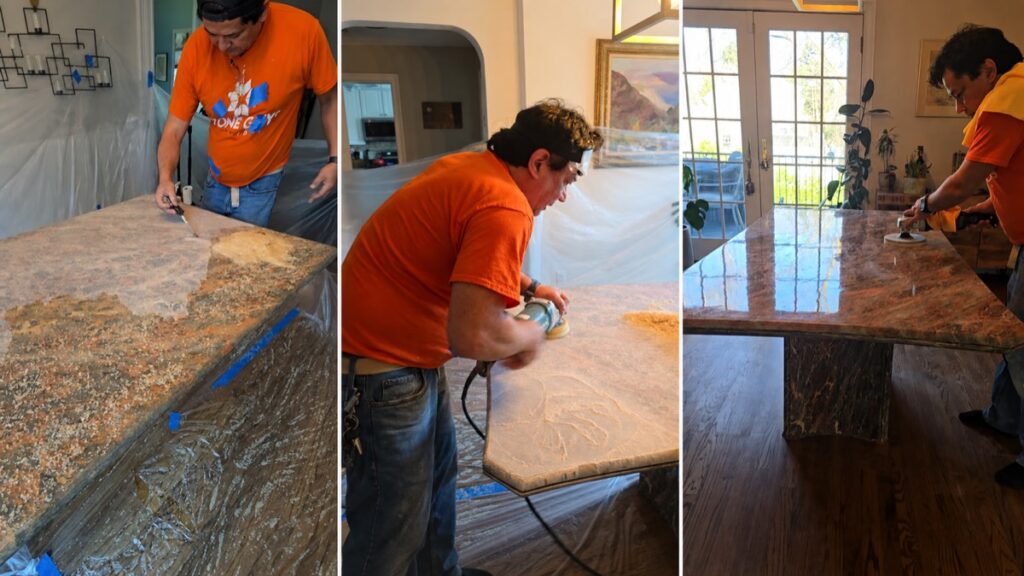
Real project: one-day stone dining table restoration
This NYC apartment project involved a stone dining table covered with a resin coating. Three Stone Guys technicians completed the restoration in one day, working from approximately 10:00 a.m. until 5:30 p.m. Although only one technician appears in the photographs, the three-person crew was needed to complete the full scope within that schedule.
The crew protected the dining room, removed the resin coating, filled chips, honed the surface, polished the stone, applied sealer, and completed a detailed cleanup. The apartment was left sparkling clean at the end of the visit.
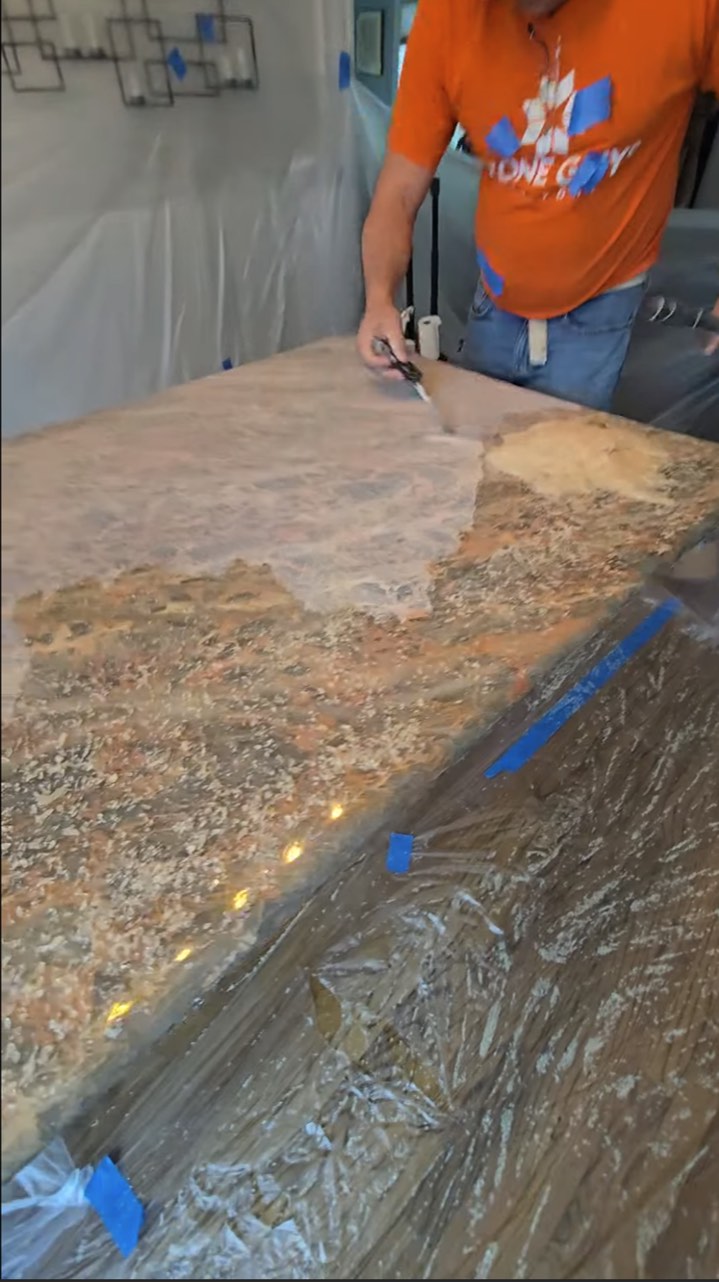
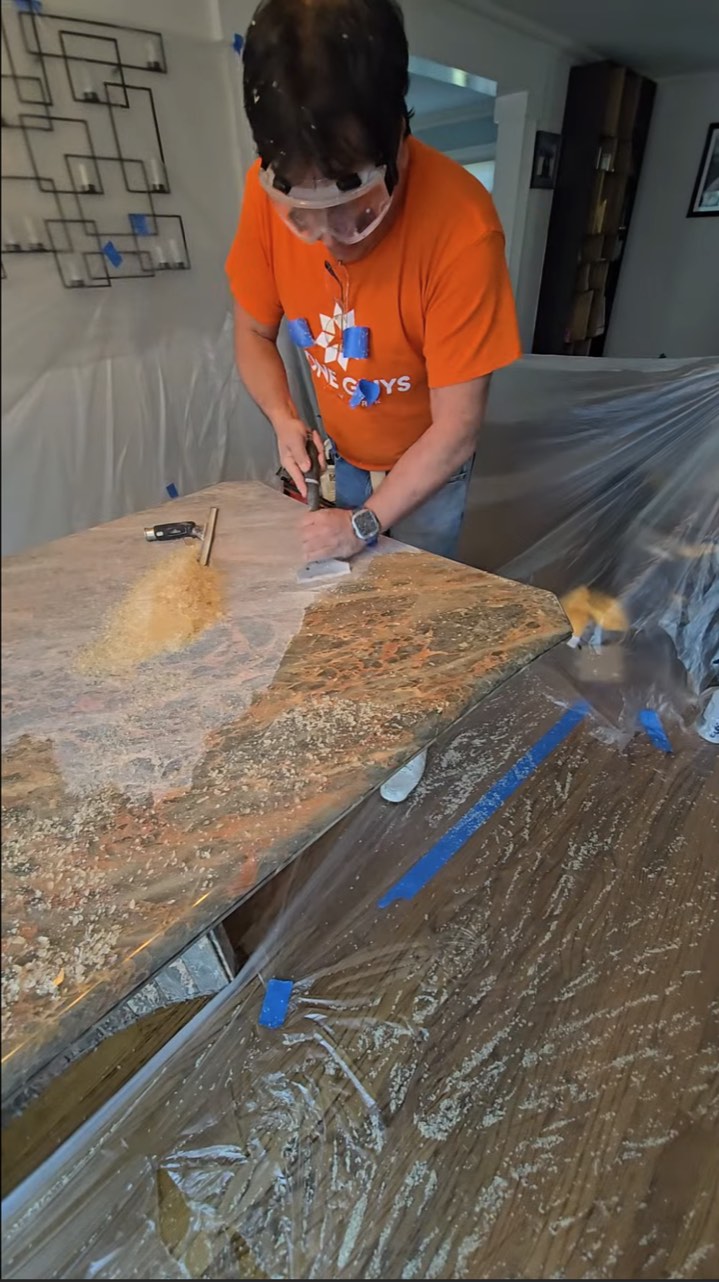
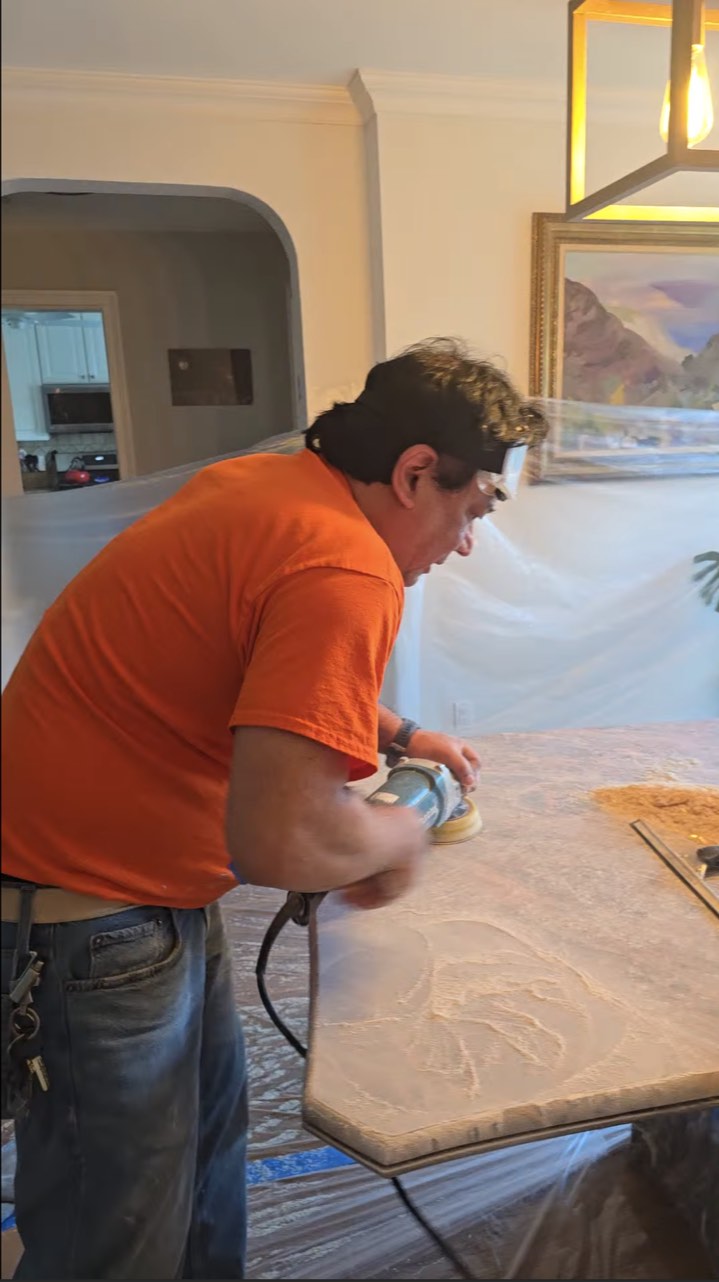
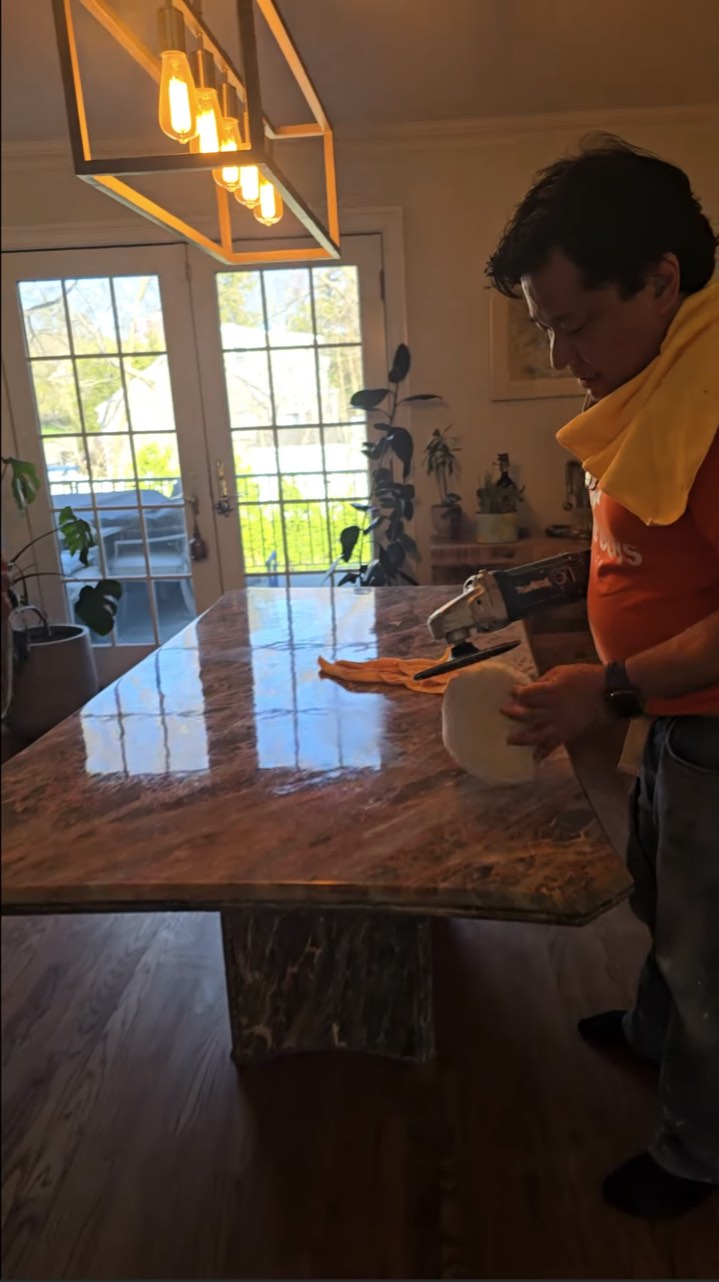
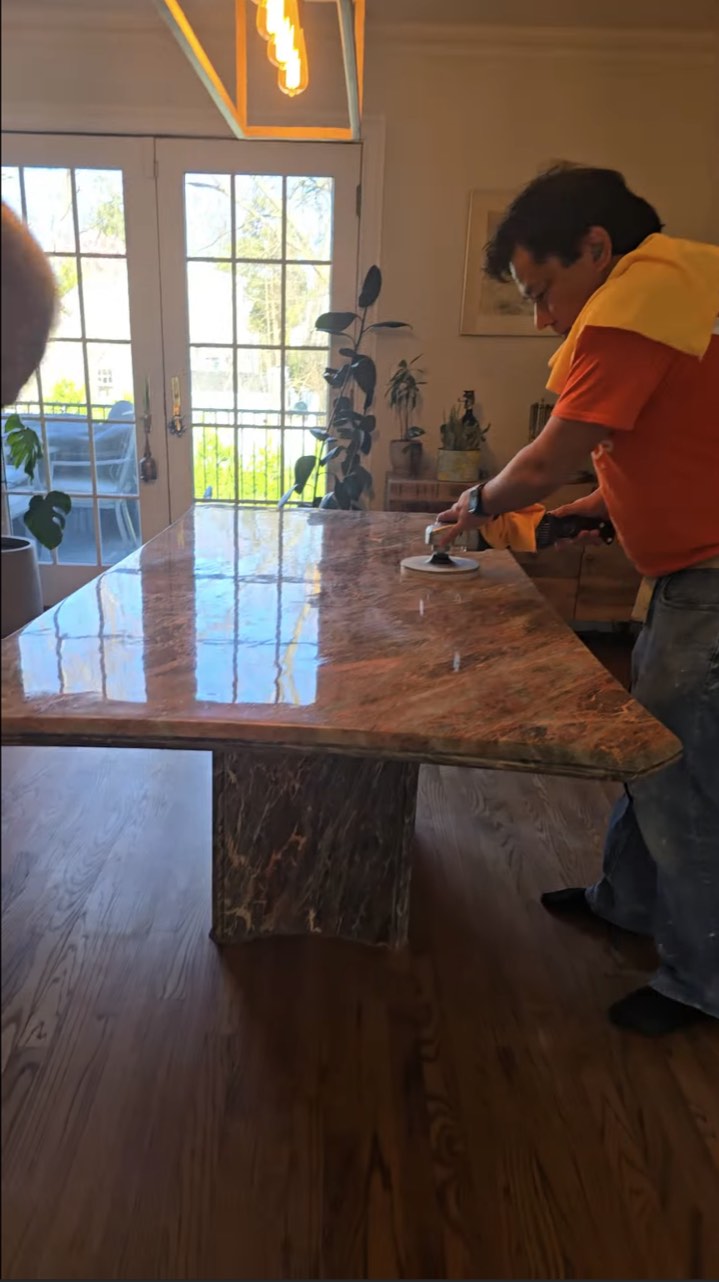
This example also shows why staffing depends on the condition and scope. Compact equipment does not mean every restoration is a one-technician project.
Finish selection
The highest shine is not always the best finish. Consider:
- Existing design and adjacent stone.
- Slip considerations.
- Water exposure.
- Traffic level.
- Maintenance expectations.
- How clearly scratches and etching will show.
Shower floors are normally better suited to a honed or high-honed finish rather than a highly polished finish. Countertops, walls, tables, and lobby floors may have different requirements.
After restoration
The technician should explain:
- When the surface may be walked on or used.
- Sealer or silicone curing time.
- Approved cleaning products.
- Products and methods to avoid.
- Which remaining characteristics are natural or outside the approved scope.
- Suggested maintenance intervals.
Avoid vinegar, acidic bathroom cleaners, harsh degreasers, abrasive powders, and unverified multipurpose chemicals on marble and other acid-sensitive stone. Use a pH-neutral product formulated for the specific surface.
What to send for an estimate
Send:
- Contact name, phone number, email, and complete project address.
- Unit number and building-management contact when applicable.
- One wide photograph of each work area.
- Close photographs of the worst damage.
- Desired finish, if known.
- Building COI sample and working-hour requirements.
- Preferred date range.
Clear photographs are generally more useful than measurements and allow a preliminary scope. If the space is large or the condition requires an in-person evaluation, Stone Guys NY will arrange an on-site consultation.
Plan the project before the crew arrives
NYC stone restoration succeeds when the technical work and building logistics are planned together. Stone Guys NY provides insured, in-house technicians for residential and commercial marble and stone restoration throughout New York City and the Tri-State Area.
To discuss a project, send photographs or call/text (888) 786-6369.