
- By stoneguysny
- In Blog
Terrazzo Floors in Commercial Buildings: Restoration and Long-Term Care
There is a moment in many commercial renovation projects when the architect pulls out terrazzo as the flooring spec and someone in the room asks: “Isn’t that what they used in old schools?” The answer is yes — and also in some of the most admired lobbies, airports, and cultural institutions built in the twentieth century. But terrazzo is no longer just a relic of mid-century public architecture. It is one of the fastest-growing flooring choices in new commercial construction across New York City, and building owners and facilities managers are discovering, sometimes for the first time, that it requires specialized care.
If your commercial building has terrazzo floors — whether they were installed in 1965 or last year — this guide will help you understand what you’re working with, what can go wrong, and how to protect one of the most durable and visually distinctive flooring materials available.
Why Terrazzo Is Back in Commercial Design
The resurgence of terrazzo in NYC commercial spaces is not nostalgia. It is driven by a combination of practical and aesthetic factors that make it genuinely well-suited to modern commercial environments.
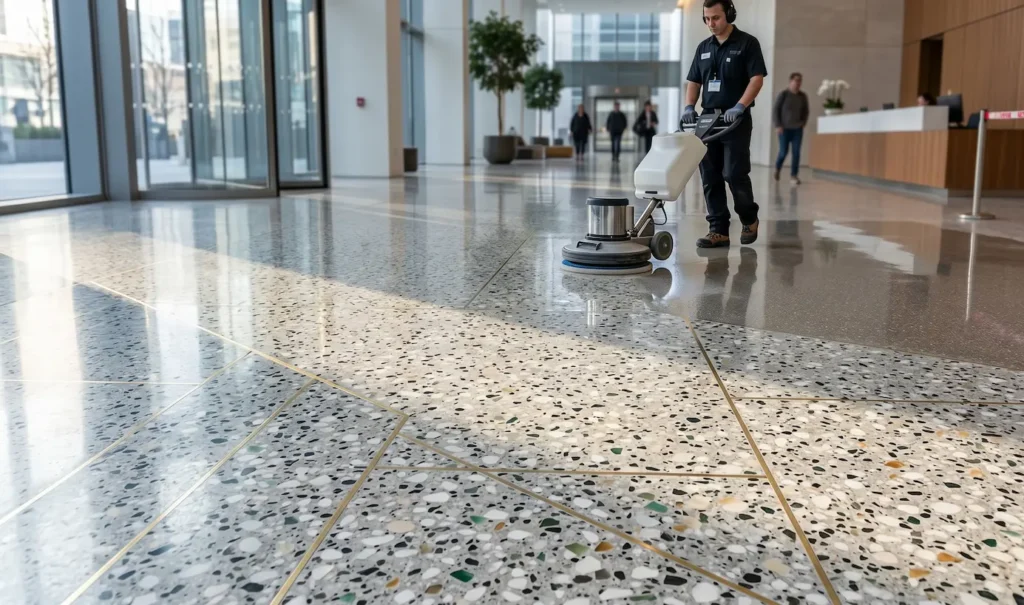
Terrazzo is composed of chips of marble, granite, quartz, glass, or other aggregates embedded in a cementitious or epoxy binder and ground flat to create a seamless, patterned surface. Because it is cast in place and ground smooth, it has no grout lines — one of its biggest advantages in high-traffic commercial settings where grout maintenance is a persistent problem.
It is also extraordinarily durable. A well-maintained terrazzo floor can last for decades — even a century — without replacement. The floors you see in pre-war NYC buildings that still look remarkable are often terrazzo. That longevity is a compelling argument for commercial property owners who think in terms of total cost of ownership rather than just installation cost.
Aesthetically, terrazzo offers a design flexibility that few other flooring materials can match. Custom colors, aggregate selections, embedded logos, and geometric patterns give architects and interior designers a canvas that is difficult to replicate in tile, stone, or polished concrete. NYC office lobbies, co-working spaces, retail flagships, and boutique hotels are all specifying terrazzo for this reason.
The challenge is that terrazzo’s resurgence has outpaced the general market’s knowledge of how to care for it. Many facility managers and cleaning contractors who are used to standard stone or tile don’t realize that terrazzo has its own maintenance requirements — and that applying the wrong treatment can cause damage that is expensive to reverse.
How Terrazzo Differs From Other Stone Floors
Understanding the difference between terrazzo and traditional stone flooring is essential before establishing any maintenance protocol.
Composition matters Unlike marble or granite, which are solid natural stone, terrazzo is a composite material. The aggregate chips are natural stone, but the binder — whether cement-based or epoxy-based — behaves differently and has different vulnerabilities. Cement-based terrazzo is more porous and sensitive to moisture and acidic cleaners. Epoxy terrazzo is denser, less porous, and more chemically resistant, but it can yellow over time under UV exposure and requires different grinding protocols when restoration is needed.
No grout lines, but expansion joints Terrazzo is poured and ground as a continuous surface, but it includes metal or plastic divider strips at regular intervals to control cracking as the substrate moves. These expansion joints are structural, not decorative, and they require attention during maintenance. Damaged or separating divider strips are a common issue in older commercial terrazzo that signals a need for professional assessment.
Grinding and honing are part of the lifecycle Unlike marble, which is typically restored through polishing, terrazzo restoration often begins with diamond grinding to remove a thin layer of the surface and expose fresh aggregate. This is a more intensive process than polishing, requires specialized equipment, and should only be performed by technicians experienced specifically with terrazzo — not just general stone restoration.
If you’re unsure what type of terrazzo your building has or what condition it’s in, a professional evaluation from a terrazzo restoration specialist in NYC is the right starting point before any maintenance work begins.
Common Problems in Commercial Terrazzo Floors
Buildings with terrazzo floors — especially those that have been in operation for many years — tend to present a recognizable set of issues. Knowing what to look for helps facilities teams catch problems early and respond appropriately.
Loss of surface gloss and clarity This is the most universal terrazzo problem and the one most commonly misattributed to the floor being “old” or “worn out.” In most cases, the loss of shine is not permanent damage — it is the result of surface abrasion from foot traffic, scratching from grit and debris, and the residue left behind by incorrect cleaning products. Professional grinding, honing, and polishing can restore the original appearance in the majority of cases.
Staining Cement-based terrazzo is porous and absorbs liquids if not properly sealed. In commercial settings, oil, food, beverages, and cleaning product residue can all cause staining. Epoxy terrazzo is less prone to staining but not immune. Stain removal on terrazzo requires stone-safe products and technique — aggressive stain removers can damage the binder or bleach the aggregate.
Cracking at expansion joints Over time, building movement causes stress at the expansion joints in terrazzo floors. Cracks that originate at divider strips are a common finding in older commercial buildings. Minor cracking can be stabilized and repaired; significant cracking that extends across tiles or follows stress lines may indicate a substrate issue that requires structural evaluation before cosmetic repair.
Divider strip separation or damage Metal divider strips can loosen, corrode, or rise above the surface level over time. This is both an aesthetic issue and a trip hazard, and it should be addressed promptly. Replacement of damaged divider strips is part of a comprehensive terrazzo restoration.
Pitting and aggregate loss In high-traffic or improperly maintained terrazzo, aggregate chips can loosen and leave small pits in the surface. This is more common in cement-based terrazzo and in floors that have experienced moisture infiltration beneath the surface. Repairing aggregate loss requires color-matched filler and skilled finishing to avoid visible patches.
📞 Is Your Commercial Terrazzo Floor Ready for a Professional Assessment?
Whether your floor needs a full restoration or a maintenance plan to protect what you have, Stone Guys NY’s terrazzo specialists can evaluate your property and deliver a clear, honest recommendation.
Request a Terrazzo Assessment for Your Building →
The Terrazzo Restoration Process: What to Expect
A full terrazzo restoration in a commercial building is a multi-step process that, when performed correctly, returns a damaged or neglected floor to a condition that is visually indistinguishable from — or better than — its original state.
Step 1: Assessment and cleaning Before any mechanical work begins, a thorough inspection identifies the type of terrazzo, the nature and extent of damage, the condition of expansion joints and divider strips, and any areas of structural concern. The floor is then deep-cleaned to remove surface contamination.
Step 2: Repairs Cracks are filled, divider strips are repaired or replaced, aggregate loss is patched with color-matched material, and any substrate issues are addressed. Repairs must cure fully before mechanical work begins.
Step 3: Diamond grinding For floors with significant surface damage, diamond grinding removes a controlled amount of the surface to expose fresh, undamaged terrazzo. The grit progression starts coarse and advances through finer grits until the desired smoothness is achieved.
Step 4: Honing Honing follows grinding to refine the surface and prepare it for polishing. This step removes the scratches left by the grinding process and begins to develop clarity in the surface.
Step 5: Polishing The final polishing steps bring the surface to its finished gloss level. Terrazzo can be finished to a matte, satin, or high-gloss polish depending on the building’s design intent and the owner’s preference.
Step 6: Sealing A penetrating sealer appropriate for the terrazzo type is applied to protect against future staining and moisture infiltration. For cement-based terrazzo in commercial settings, sealing is particularly important and should be renewed on a regular schedule.
This process requires a team with specific terrazzo experience, the right diamond tooling, and an understanding of how different aggregate and binder combinations respond to mechanical treatment. The results of a professional restoration, when done correctly, are transformative — floors that looked permanently damaged return to a condition that reflects well on the building and its management.
Maintenance Intervals for Heavy-Traffic Commercial Floors
Once a terrazzo floor has been restored or is in good condition, the goal is to maintain that condition through a regular service schedule rather than allow it to degrade to the point where another full restoration is needed.
For high-traffic commercial buildings in NYC — office towers, retail centers, mixed-use buildings, and hospitality properties — a reasonable terrazzo maintenance schedule looks like this:
Daily: Dry dust mopping to remove grit and debris before it becomes abrasive under foot traffic. This single habit has more impact on the long-term condition of a terrazzo floor than almost any other intervention.
Weekly or Bi-Weekly: Damp mopping with a pH-neutral, terrazzo-safe cleaner. No acidic, alkaline, or wax-based products. Wax in particular is a common and damaging mistake — it builds up over time, yellows, and must be stripped before any professional restoration can be performed.
Every 6 to 12 Months: Professional cleaning, light honing if needed, and re-sealing. The interval depends on traffic volume and the floor’s current condition.
Every 3 to 7 Years: Full professional re-polishing to restore gloss and address accumulated surface wear. With consistent maintenance, this interval can often be extended.
Communicating these protocols to your building’s cleaning contractor is essential. Many cleaning companies that are perfectly competent on standard floors don’t have experience with terrazzo and will default to products and techniques that cause long-term damage. A conversation with your stone care provider about what to tell your cleaning team — and what products to specify — is worth having before a new contractor starts.
For more context on how stone care fits into a broader building maintenance strategy, our guide on marble lobby maintenance for NYC building managers covers the operational principles that apply across stone types in commercial environments.
Why Terrazzo Expertise Matters
Not every stone restoration company has genuine terrazzo expertise. Terrazzo restoration requires different equipment, different diamond tooling, and a different approach than marble or granite work. A technician who is excellent at marble polishing but has limited terrazzo experience can inadvertently cause damage — particularly when it comes to matching repairs, setting the right grinding depth, or selecting appropriate sealers for cement-based vs. epoxy terrazzo.
When evaluating a stone care provider for commercial terrazzo work, ask specifically about their terrazzo experience: how many commercial terrazzo projects they’ve completed, whether they can provide references from building managers or facilities directors, and whether they can identify the type of terrazzo in your building before quoting.
Stone Guys NY has worked on terrazzo floors in commercial buildings, residential lobbies, and hospitality properties across NYC. Our team includes technicians with specific terrazzo experience who understand both the restoration process and the operational constraints of working in active commercial environments.
🏢 Protect Your Building’s Terrazzo Investment
Terrazzo is one of the most durable and beautiful commercial flooring options available — but only when it’s properly maintained. Stone Guys NY can assess your floor’s current condition and build a restoration or maintenance plan that fits your building’s schedule and budget.
Contact Stone Guys NY for a Free Commercial Terrazzo Assessment →
Stone Guys NY provides professional terrazzo, marble, limestone, granite, and natural stone restoration and maintenance for commercial buildings, hotels, and residential properties across New York City. Call us at (888) 786-6369 or email info@StoneGuysNY.com.


LEAVE A COMMENT