
- By stoneguysny
- In Blog
The First Impression Problem: Why Your Building’s Lobby Stone Tells Tenants Everything
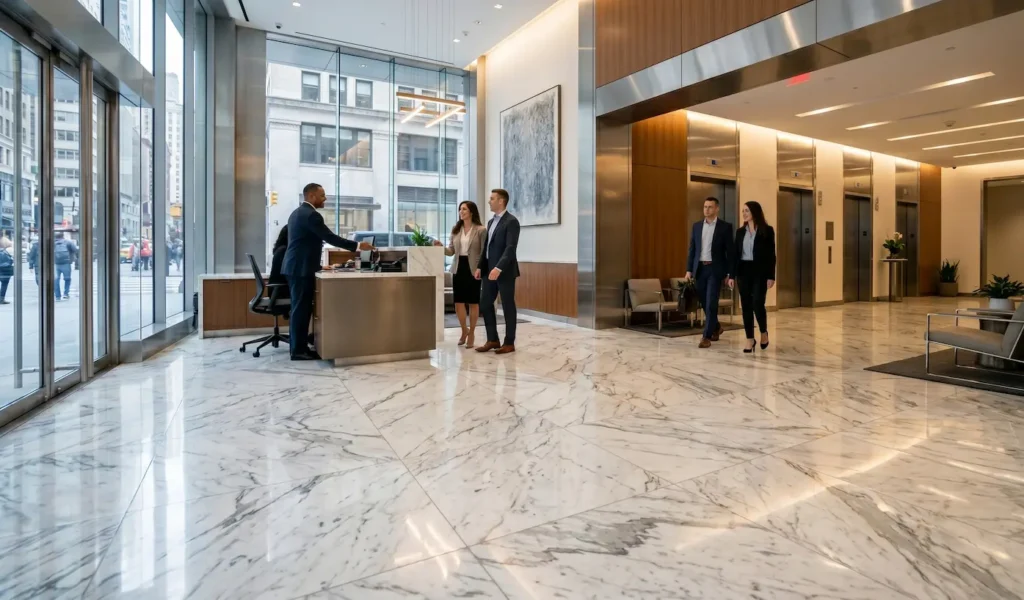
In New York City real estate, decisions are made fast. A prospective tenant touring a commercial space, a buyer walking through a condo for the first time, a corporate client visiting a building for a meeting — all of them form a judgment about the property within seconds of walking through the front door. Before the square footage is discussed, before the amenities are listed, before anyone mentions the lease terms, the lobby has already spoken.
And the lobby’s most powerful communicator is its stone floor.
A polished, well-maintained marble or granite lobby says something specific: this building is managed with attention to detail. Standards are upheld here. The ownership cares about the asset. That message reaches the visitor before a single word is exchanged — and it shapes every subsequent impression they form during the tour.
A dull, scratched, or stained lobby floor delivers the opposite message just as efficiently. It raises questions that visitors may never voice but that influence their decision nonetheless: What else isn’t being maintained? What will the building look like in five years? Is the management as distracted as this floor suggests?
This article is for building owners, property investors, and real estate managers who want to understand the direct relationship between lobby stone condition and property value — and what it actually costs to let that relationship go unmanaged.
How Prospective Tenants and Buyers Evaluate Lobbies
Research in commercial and residential real estate consistently shows that first impressions are formed within the first few seconds of entering a space and are remarkably resistant to revision. A visitor who forms a negative initial impression of a lobby will spend the rest of the tour filtering subsequent information through that lens, looking for confirmation rather than contradiction.
This is not a quirk of perception. It is how human judgment works, and it has direct commercial implications for property owners.
In competitive NYC markets — where comparable units in comparable buildings are regularly available and tenants have real choices — the lobby is often the differentiator. Two buildings with similar layouts, similar amenities, and similar locations will not feel equally appealing if one has a lobby that looks professionally maintained and the other has one that shows visible neglect. The difference in how those buildings are perceived will be reflected in inquiry rates, time on market, and ultimately in the prices they command.
Commercial tenants making decisions about office space are equally influenced. A corporation choosing between two buildings for its headquarters or regional office is evaluating everything — including what the lobby will communicate to its own clients and employees who pass through it every day. A lobby floor that looks tired signals a building that will look tired, and sophisticated commercial tenants factor that into their evaluation.
The same logic applies to prospective buyers in the residential market. In a city where co-op and condo lobbies serve as the face of a building’s community and management standards, a worn or poorly maintained lobby stone floor is a visible data point that buyers use to draw inferences about the building’s overall condition and governance.
The Connection Between Lobby Condition and Property Value
The link between building appearance and appraised value is well established in the commercial real estate industry. Appraisers and lenders assess the condition of common areas as part of their evaluation, and buildings with visibly neglected common spaces are discounted accordingly.
For residential buildings, the lobby’s condition affects not just the perceived value of individual units but the desirability of the building as a whole — which affects how quickly units sell, how much they sell for, and whether the building attracts the caliber of residents that sustains and improves its reputation over time.
For commercial properties, the lobby condition affects lease rates, tenant retention, and the building’s competitiveness for high-quality tenants who have options. A Class A building with a Class B lobby will struggle to maintain Class A rents. A building that lets its lobby deteriorate over time signals to the market that management is not actively invested in maintaining the asset — and the market prices that signal accordingly.
These are not theoretical concerns. They are the practical consequences of a maintenance decision that building owners and property managers make — or fail to make — every year.
Investing in professional marble restoration services or granite maintenance for a building’s lobby is not an aesthetic indulgence. It is a direct investment in the property’s market position, its ability to attract and retain quality tenants, and its long-term appraised value.
Real Damage Scenarios: What a Worn Lobby Floor Signals
It helps to be specific about what “visible neglect” actually looks like in a lobby floor — and what each type of damage communicates to the people who see it.
Dull, hazy surface in traffic pathways When the main traffic path through a lobby — from the entrance to the elevator bank — is visibly duller than the rest of the floor, it tells every observant visitor that the building hasn’t had professional stone maintenance in years. The differential wear pattern is unmistakable once you know what to look for, and experienced commercial real estate professionals, property managers, and sophisticated buyers absolutely know what to look for.
Staining near the entrance or concierge area Visible stains in a lobby’s most prominent zones communicate that spills aren’t addressed promptly and that stone isn’t sealed or maintained properly. In a residential building, this raises questions about management’s responsiveness. In a commercial building, it raises questions about cleanliness standards that can affect tenant attraction in sectors where image matters — law firms, financial services, healthcare, and client-facing businesses of all kinds.
Scratched or chipped stone near elevator banks The area in front of elevator doors takes constant abuse from moving equipment. Visible scratches and chips in this zone — one of the first things a visitor sees when they enter a lobby — communicate a lack of preventive maintenance and a reactive management style that sophisticated tenants and buyers will note.
Deteriorated or discolored grout lines Dark, stained, or visually inconsistent grout lines make an otherwise clean lobby look dirty. They also signal moisture management issues and a maintenance gap that has compounding consequences over time.
Mismatched repairs or patchy appearance When stone damage has been addressed piecemeal — one section polished here, one stain treated there — the result is often a floor that looks more inconsistent than it would have if nothing had been done. Poorly executed spot repairs are a visible sign of DIY maintenance attempts or inexperienced contractors, which raises its own questions about the property’s management standards.
Each of these conditions is correctable. The question is whether they’re addressed before the building pays the cost of the impression they create — in lost tenants, reduced rents, longer vacancy periods, or lower sale prices.
📞 Before Your Next Tenant Showing or Property Tour
Stone Guys NY works with building owners and property managers across NYC to restore and maintain lobby stone ahead of lease renewals, property listings, and portfolio assessments.
Schedule a Free Lobby Stone Assessment →
The Cost of Restoration Now vs. Replacement Later
One of the most consistent findings in commercial property maintenance is that deferred care always costs more than timely intervention. This is true for HVAC systems, building envelopes, and elevators — and it is equally true for stone floors.
A lobby floor in early-stage deterioration — surface dullness, minor scratching, light staining — can typically be restored to excellent condition through professional polishing, stain treatment, and re-sealing. This is a relatively straightforward process with a moderate cost and minimal operational disruption.
That same floor, left unaddressed for another two or three years, may reach a point where polishing alone is insufficient. Grinding and honing — more intensive mechanical processes that remove more of the stone’s surface — become necessary. The cost increases substantially, and the process takes longer.
A floor that has been significantly neglected may eventually require full replacement — removing the existing stone and installing new material. In a large commercial lobby in New York City, that is a six-figure project that takes weeks, displaces building operations, and creates months of construction disruption for tenants and residents.
The math is not ambiguous. A consistent maintenance program — professional polishing and re-sealing on a scheduled interval, spot treatments as needed, and a standing relationship with a qualified stone care provider — costs far less over ten years than a cycle of deferred maintenance followed by emergency restoration or replacement.
For building owners who want a concrete picture of their current situation, a professional stone restoration assessment identifies exactly what the building’s stone needs now, what the cost of addressing it is, and what a maintenance plan to prevent future deterioration would look like.
How a One-Time Restoration Plus Maintenance Plan Protects the Investment
The most effective approach for buildings whose lobby stone has already experienced some degree of deterioration is a two-phase strategy: a one-time professional restoration that brings the surface back to its best condition, followed by a scheduled maintenance program that keeps it there.
The restoration phase addresses everything that has accumulated — surface abrasion, etching, staining, grout discoloration, minor chips — and returns the floor to a condition that makes a genuinely positive first impression. Depending on the stone type and the extent of the damage, this may involve polishing, honing, stain removal, grout cleaning and sealing, and surface re-sealing.
The maintenance phase ensures that the investment in restoration is protected going forward. Scheduled professional visits at appropriate intervals — typically every six to twelve months depending on traffic volume — keep the surface in excellent condition without allowing damage to accumulate to the point where another major restoration is needed.
This two-phase model is how the buildings in NYC that consistently look well-maintained actually maintain their appearance over time. It is not magic, and it is not an unlimited budget — it is a planned, disciplined approach to protecting a significant capital asset.
For buildings managing multiple stone surface types across lobbies, corridors, and common areas, our articles on marble lobby maintenance and terrazzo floors in commercial buildings provide stone-specific guidance that complements the broader framework discussed here.
The Competitive Advantage of a Well-Maintained Lobby
In a market as competitive as New York City real estate, every meaningful differentiator matters. Buildings compete for tenants, for buyers, for favorable appraisals, and for the kind of reputation that creates a self-reinforcing cycle of quality — good tenants attract good tenants, high standards attract buyers willing to pay for high standards, and a well-maintained building is easier and less expensive to keep well-maintained than one that has been allowed to deteriorate.
The lobby is where that cycle starts. It is the building’s public face, its first statement to anyone who enters, and the most efficient communicator of management quality available. A lobby stone floor in excellent condition is not just aesthetically pleasing — it is a business asset that pays dividends in lease rates, occupancy, tenant retention, and property value every single day.
The cost of maintaining that asset at a professional level is modest relative to what it protects. The cost of neglecting it is measured in lost opportunities that rarely appear on any line item — but are felt in every lease negotiation, every property showing, and every appraisal the building receives.
🏢 Protect What Your Lobby Communicates About Your Building
Stone Guys NY helps building owners and property managers across NYC restore and maintain lobby stone to the standard their properties deserve. From one-time restorations to long-term maintenance programs, we work around your schedule and your budget.
Contact Stone Guys NY for a Free Building Assessment →
Stone Guys NY provides professional marble, granite, limestone, terrazzo, travertine, and natural stone restoration and maintenance for commercial buildings, residential properties, and hotels across New York City. Call us at (888) 786-6369 or email info@StoneGuysNY.com.


LEAVE A COMMENT