
- By stoneguysny
- In Blog
Travertine in Hotel Spas and Wellness Areas: Care Guide for Hospitality Professionals
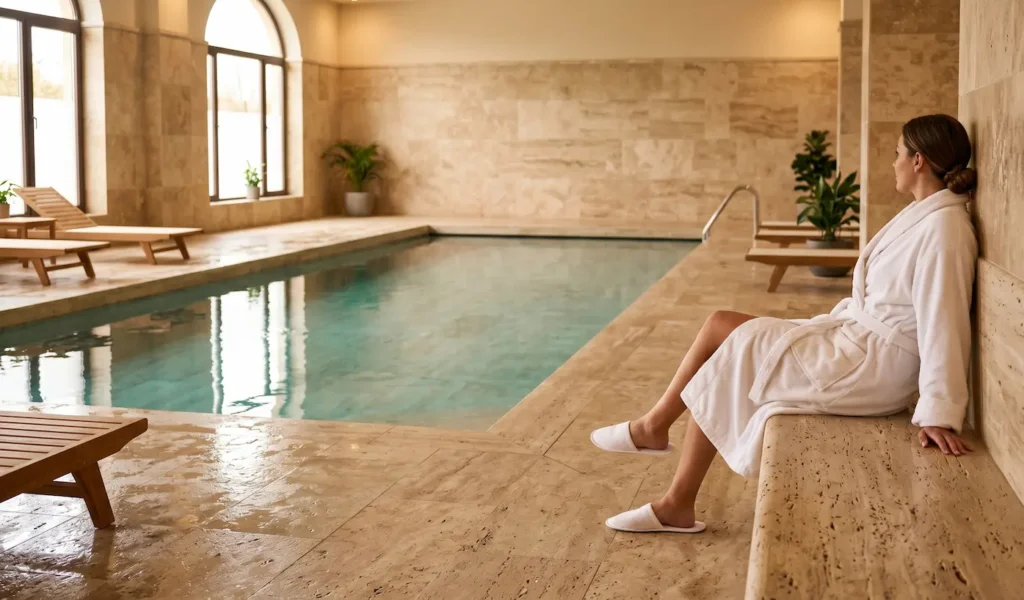
Walk into the spa of almost any full-service hotel in New York City and there is a reasonable chance the floor beneath your feet is travertine. The warm, earthy tones, the naturally textured surface, the subtle variation in pattern — travertine has become the defining material of upscale wellness environments because it communicates exactly what a spa is supposed to communicate: calm, naturalness, and a connection to something elemental.
It is also one of the most demanding stone surfaces to maintain in a commercial hospitality setting.
The same qualities that make travertine beautiful — its porosity, its natural pitting, its organic variation — make it uniquely vulnerable to the conditions found in hotel spas and wellness areas. Constant moisture, chemical exposure from treatments and cleaning products, high foot traffic on wet surfaces, and the specific mechanical demands of a 24/7 hospitality operation combine to create maintenance challenges that most hospitality facilities teams are not fully equipped to manage without professional support.
This guide is written for hotel spa managers, wellness facility directors, and hospitality facilities teams who want to understand what travertine actually requires in a spa environment — and how to build a care program that keeps the stone performing and looking the way it was designed to.
Why Travertine Is So Popular in Spa and Wellness Design
Travertine is a sedimentary limestone formed by mineral springs, and its geological origin gives it a visual character that no engineered or synthetic material fully replicates. The stone’s natural pitting, its warm palette of creams, golds, and russets, and the way it takes and holds light make it a natural fit for environments designed around relaxation and sensory experience.
From a practical design perspective, travertine also offers tactile variation that polished marble or granite cannot. Its textured surface — whether left naturally open or filled and honed to a smoother finish — provides a level of grip that is relevant in wet spa environments where slip resistance is both a safety requirement and a design consideration.
Architecturally, travertine is extremely versatile. It works as floor tile, wall cladding, shower surrounds, pool decking, steam room walls, and feature surfaces throughout a spa’s journey sequence. A well-designed spa can use travertine consistently from the arrival area through the treatment rooms, locker rooms, and relaxation pools, creating a material continuity that reinforces the immersive experience.
For all of these reasons, travertine has become a near-default specification in upscale hotel spa design. What changes between a well-maintained spa and a poorly maintained one is not what the travertine looked like when it was installed — it is what it looks like after two, five, or ten years of operation.
The Unique Challenges of Spa Travertine Maintenance
Hotel spas create a specific combination of stressors that are unlike any other commercial environment. Understanding each one is essential for building a maintenance program that addresses them effectively.
Constant moisture and humidity Spa environments are wet by definition. Pool surrounds, steam rooms, wet treatment areas, and shower floors maintain near-constant moisture exposure that accelerates virtually every form of stone deterioration. Moisture penetrates travertine’s natural pores and pitting, promotes mineral deposit buildup, encourages biological growth, and — in poorly sealed stone — can eventually cause sub-surface damage that is expensive to repair.
Pool and treatment chemicals Chlorine, bromine, and the range of pH-adjustment chemicals used in hotel pool and hydrotherapy maintenance are harsh on natural stone. Chlorine in particular can bleach and etch travertine over time, especially in areas where pool water splash or overflow makes regular contact with the stone. Treatment oils, exfoliation products, and other spa service materials add another layer of chemical exposure in treatment room floors and surfaces.
Cleaning product incompatibility Many standard commercial cleaning products are inappropriate for travertine. Acidic cleaners — which include many bathroom and tile descalers — will etch travertine’s calcium carbonate surface on contact. Alkaline cleaners used at incorrect dilutions can strip sealers and open the stone’s pores. Without clear product specifications and staff training, daily cleaning becomes a source of cumulative damage rather than protection.
High foot traffic on wet surfaces Barefoot traffic in wet conditions creates a specific wear pattern on travertine. The abrasion is different from shod foot traffic in a dry lobby, but over time the cumulative effect on surface finish is significant — particularly in the highest-traffic zones like pool entry points, locker room thresholds, and corridor connections between wet and dry areas.
Slip resistance requirements and their interaction with maintenance Travertine’s natural texture provides inherent slip resistance, but maintenance decisions can affect this. Over-polishing reduces grip. Certain sealers reduce grip. Biological growth — algae and mold — dramatically reduces grip. A maintenance program that doesn’t account for slip resistance outcomes can inadvertently create safety hazards, which in a commercial hospitality setting carries liability implications beyond the aesthetic concern.
Common Problems Found in Hotel Spa Travertine
The damage patterns that develop in neglected or improperly maintained hotel spa travertine are consistent and recognizable. Facilities teams should know what to look for during regular inspections:
Mineral deposit buildup and hard water scaling Calcium and mineral deposits from pool water, shower water, and humidification systems accumulate on travertine surfaces as white or gray crusty deposits. In areas with heavy water exposure, this buildup can be significant. Removing it requires stone-safe descaling products and technique — aggressive acid-based scale removers will etch the travertine while removing the deposits, compounding the problem.
Biological growth in pitting and grout lines Travertine’s natural pitting creates micro-environments where moisture, organic material, and warmth combine to support mold, mildew, and algae growth. In spa environments, this is not a rare occurrence — it is an ongoing management challenge. Visible darkening in pits and grout lines, musty odor, and slippery surface texture in wet zones are all indicators of biological growth that requires professional-grade treatment and a preventive sealing program.
Etching from cleaning products or treatment chemicals Etch marks on travertine appear as dull, lighter-colored areas where the stone’s surface has been chemically dissolved. In spa environments, etching commonly results from inappropriate cleaning products used by housekeeping staff, acidic treatment products that contact floor surfaces, or pool chemical exposure. Etching cannot be cleaned away — it requires professional honing or polishing to remove.
Open pitting and surface deterioration Unfilled travertine, or travertine where original filler has deteriorated over time, develops increasingly open pitting as the stone is used. In spa environments, open pits collect debris, moisture, treatment residues, and biological matter — accelerating deterioration and creating an appearance that is difficult to reverse without professional restoration. Refilling and resealing open travertine is a standard part of a comprehensive spa stone restoration.
Grout failure and joint deterioration The grout and caulk joints in spa travertine installations are under constant stress from moisture, temperature variation, chemical exposure, and foot traffic. Failed joints allow water infiltration into the substrate, which can cause significant structural damage over time. Regular inspection of joints — particularly in wet zones — and prompt repair of any failures is essential preventive maintenance.
Our travertine restoration services are specifically designed for the conditions found in commercial hospitality environments, including the scheduling constraints and operational considerations that spa facilities management requires.
🧖 Is Your Hotel Spa Travertine Due for Professional Assessment?
Stone Guys NY works with hotel spa and wellness facilities across NYC to restore and maintain travertine surfaces without disrupting your guest experience. Overnight and phased scheduling available.
Request a Spa Stone Care Consultation →
Filling and Sealing Travertine: When and How Often
Sealing is the most important single maintenance intervention for travertine in spa environments — and it is also the most frequently deferred. The logic for deferral is usually that the stone “looks fine,” which misses the point: sealing is preventive, not corrective. By the time you can see the consequences of inadequate sealing, the damage has already occurred.
Filling open travertine Travertine is available in filled and unfilled varieties. Filled travertine has its natural pits filled with grout or epoxy filler during installation; unfilled travertine retains its open pitting. In spa environments, unfilled or partially filled travertine requires periodic re-filling as original filler deteriorates. This is typically done as part of a comprehensive restoration and should precede re-sealing.
Penetrating sealers for spa environments The appropriate sealer for spa travertine is a penetrating (impregnating) sealer — not a topical or coating-type sealer. Penetrating sealers enter the stone’s pores and provide protection from within without creating a surface film that can become slippery, peel, or trap moisture. In spa environments, sealer selection should account for the specific chemicals the stone will be exposed to, including pool chemicals if applicable.
Re-sealing frequency In high-use spa environments with frequent chemical exposure and constant moisture, travertine should be re-sealed every twelve to eighteen months. Water bead testing is a simple field check: pour a small amount of water on the surface. If it beads up, the sealer is effective. If it absorbs within a few minutes, re-sealing is overdue.
After any restoration work Whenever travertine receives professional grinding, honing, or polishing, the mechanical process opens the stone’s pores and removes existing sealer. Re-sealing after any restoration work is not optional — it is an essential final step that protects everything that came before it.
Slip Resistance Considerations in Spa Stone Maintenance
In any commercial hospitality setting, slip resistance is both a safety and a liability concern. In a spa — where guests walk barefoot on wet surfaces — it is a primary operational consideration that must be integrated into every stone maintenance decision.
Travertine’s natural finish provides reasonable slip resistance, but this can be affected by maintenance choices:
Polishing level matters. High-gloss polished travertine is beautiful but more slippery when wet than honed or brushed finishes. In wet zones — pool surrounds, shower floors, wet treatment areas — the finish specification should prioritize slip resistance over aesthetics. A skilled stone restoration technician can deliver a finish that balances both.
Sealer type matters. Some sealers leave a surface film that reduces grip, particularly when wet. Penetrating sealers that don’t alter the surface texture are the appropriate choice for wet spa environments. Topical sealers and wax-based products should never be used in wet spa stone applications.
Biological growth is a serious slip hazard. Algae and biofilm on wet travertine dramatically reduces coefficient of friction. Regular professional treatment and a preventive sealing program are the most effective tools for managing biological growth in wet spa environments.
For context on how these principles apply to other stone types in hotel environments — particularly lobby and common area surfaces — our article on how hotels keep their stone floors looking flawless year-round covers the broader hospitality maintenance framework.
Building a Spa-Specific Stone Care Program
The most effective approach to hotel spa travertine maintenance is a documented, scheduled program that integrates daily cleaning protocols, periodic professional service, and annual condition assessment. Key elements of a comprehensive spa stone care program:
Daily cleaning protocol Specify pH-neutral, stone-safe cleaning products for all daily housekeeping. Post product specifications in storage areas and train staff on correct dilution, application, and drying. Prohibit any acid-based or alkaline cleaning products in areas with travertine. Establish immediate spill response procedures for treatment products.
Weekly or bi-weekly deep cleaning Professional-grade stone-safe cleaning of all travertine surfaces, including grout lines and pitting, with equipment appropriate for the surface finish and wet environment.
Quarterly professional inspection A trained stone technician visits to assess sealer effectiveness, identify biological growth, check joint condition, and document any emerging issues before they become significant damage.
Annual restoration service Depending on the spa’s use intensity, an annual professional service visit — including professional cleaning, targeted honing or polishing where needed, joint inspection and repair, and full re-sealing — maintains the stone at a consistent standard and extends the interval before major restoration is required.
Dedicated service relationship Spa stone maintenance works best when the same technician or team services the property consistently. Familiarity with the specific installation, the stone type, the water chemistry, and the facility’s operational constraints leads to better outcomes than rotating between providers or calling a new company each time a problem arises.
Stone Guys NY provides marble, limestone, and travertine maintenance for hotel and hospitality properties across New York City, with scheduling designed to accommodate the 24/7 operational requirements of active spa and wellness facilities.
🏨 Your Spa’s Stone Deserves Specialized Care
Travertine in a hotel spa is a significant investment in your guests’ experience. Stone Guys NY provides the specialized expertise and hospitality-aware scheduling to keep it performing and looking the way it was designed to — year after year.
Schedule a Free Hotel Spa Stone Assessment with Stone Guys NY →
Stone Guys NY provides professional travertine, marble, limestone, terrazzo, and natural stone restoration and maintenance for hotels, spas, residential buildings, and commercial properties across New York City. Call us at (888) 786-6369 or email info@StoneGuysNY.com.


LEAVE A COMMENT