
- By Escala SEO
- In Blog
How to Remove Etch Marks from Marble Countertops
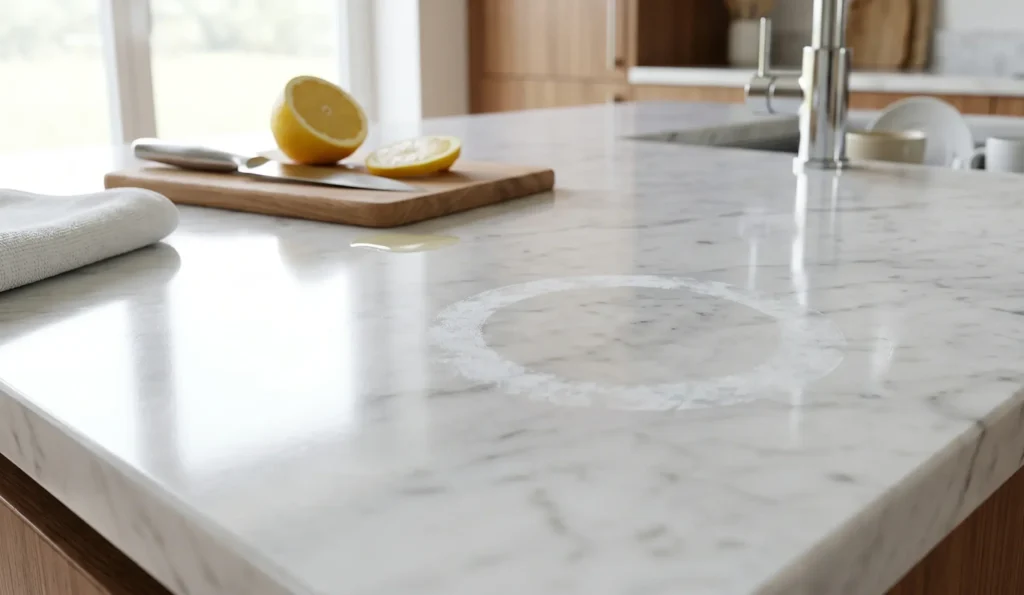
You set a lemon wedge on your marble kitchen counter, wipe it away a few minutes later, and notice a dull, hazy ring where it sat. Or maybe a glass of wine was left overnight and now there’s a cloudy spot that no amount of wiping seems to fix. You might assume it’s a stain — something that soaked into the stone. But in most cases, what you’re looking at is an etch mark, and it’s a very different problem that requires a very different solution.
Understanding what marble etching actually is — and what it isn’t — is the first step toward restoring your countertop to its original beauty. This guide will walk you through everything you need to know, from the science behind etching to why professional marble honing and polishing in NYC is often the most reliable path to a lasting repair.
What Are Etch Marks on Marble?
Etch marks are a form of physical surface damage. Unlike stains, which occur when a substance is absorbed into the pores of the stone and causes discoloration from within, etching happens at the very surface of the marble itself — the finish is chemically eroded, leaving the stone microscopically rougher in that area.
Marble is composed primarily of calcium carbonate, a mineral that reacts when it comes into contact with acids. Even mild acids can trigger this reaction, dissolving the surface of the stone on a microscopic level. The result is a dull, flat, or cloudy patch that stands in stark contrast to the surrounding polished surface.
On honed marble (which already has a matte finish), etch marks can be harder to detect visually but may still feel rough to the touch. On polished marble — the high-gloss finish common on kitchen countertops, vanities, and bar tops — etch marks are usually immediately noticeable because the dull area breaks the reflective uniformity of the surface.
What Causes Marble Countertop Etching?
Almost any acidic substance can etch marble if it makes contact with the surface long enough. Some of the most common culprits include:
- Lemon juice and citrus fruits — Even briefly resting a cut lemon on marble can cause etching
- Vinegar — A popular household cleaner that is highly damaging to calcium carbonate stones
- Wine — Both red and white wine are acidic enough to leave etch marks, especially with prolonged contact
- Coffee — Acidic and often left in mugs placed directly on countertops
- Tomato sauce and tomato-based products — A frequent kitchen offender
- Harsh cleaning sprays — Many all-purpose cleaners, bathroom tile cleaners, and grout products contain acids or alkaline chemicals that degrade marble finishes
- Perfumes, colognes, and personal care products — Particularly common on marble bathroom vanities; many contain alcohol or acidic compounds
One of the most important things to understand is that you do not need to leave a substance on the stone for a long time to cause damage. High-acid substances like lemon juice or vinegar can begin etching polished marble within seconds.
Is It an Etch Mark or a Stain?
This is one of the most common points of confusion for marble countertop owners — and getting it right matters, because the treatment is completely different.
| Etch Mark | Stain | |
| Appearance | Dull, hazy, cloudy, or matte patch | Darker or differently colored area |
| Cause | Acid reacting with the stone surface | A substance absorbed into the stone’s pores |
| Texture | Often slightly rough or uneven to the touch | Usually the same texture as surrounding stone |
| Location | On the surface of the stone | Inside the stone |
| Solution | Honing and polishing | Poultice or deep cleaning treatment |
It is also possible to have both simultaneously. If a colored, acidic liquid like red wine or coffee is left on marble long enough, it can etch the surface and leave a stain beneath it. In these cases, a professional stone restoration specialist will need to address both issues separately.
When in doubt, run your finger across the mark. If it feels rougher or less smooth than the surrounding marble, it is very likely an etch.
Can You Remove Marble Etch Marks Yourself?
For very light, superficial etching — a faint haze caused by brief contact with a mildly acidic substance — marble polishing powder (sometimes sold as marble etch remover) may produce some improvement. These products work by using a mild abrasive to even out the surface and restore some shine.
However, there are important limitations to the DIY approach:
- Polishing powder is only effective on light surface etching. Deeper or more widespread etching requires mechanical honing with professional equipment.
- Uneven application can create new problems. If the powder is applied too aggressively or unevenly, you can create a patchy finish that is more noticeable than the original etch mark.
- Most homeowners do not have the equipment or experience to match a factory-polished surface finish, especially on exotic or high-value marbles.
- Risky methods like baking soda pastes, toothpaste, or steel wool should be avoided entirely. These can scratch the stone, alter the finish permanently, or make professional restoration more difficult.
For moderate to severe etching, for multiple etch marks across a large area, or for high-end marble where appearance is a priority, professional marble honing and polishing is the recommended course of action.
Why Professional Honing and Polishing Works
Professional marble restoration goes far beyond what any DIY product can achieve. Stone Guys NY’s marble restoration services use a multi-step process designed to address etching at the source — the surface structure of the stone — rather than just masking the damage.
Here is how a professional marble countertop restoration typically works:
1. Surface Inspection A technician evaluates the extent of the etching, checks for any accompanying staining, and assesses the current finish level of the stone. This determines which grit sequence and technique will be used.
2. Honing to Remove Surface Damage Using diamond abrasive pads at progressively finer grits, the technician gently removes the top layer of the stone where the etching has occurred. This levels out the surface and eliminates the dull, rough areas.
3. Progressive Polishing After honing, the surface is polished through multiple stages to gradually build up the reflective finish. The goal is to match the original gloss level of the surrounding marble, resulting in a uniform, seamless appearance.
4. Optional Sealing While sealing does not prevent etching (more on this below), it can help protect marble from staining. A technician may apply an impregnating sealer as part of the restoration process.
5. Maintenance Guidance A reputable stone care company will walk you through what products to use, what to avoid, and how to maintain your countertop going forward to prevent future damage.
The result is a countertop that looks as close to its original state as possible — often indistinguishable from new stone. You can browse real before-and-after results from Stone Guys NY to see the difference professional restoration makes.
How to Prevent Future Etching on Marble Countertops
Once your marble has been professionally restored, protecting that investment is much easier with a few consistent habits:
- Always use cutting boards — Never cut citrus fruits, tomatoes, or any food directly on marble
- Use coasters under all glasses and bottles — Wine, juice, vinegar-based dressings, and even some waters can etch marble
- Wipe up spills immediately — The faster you act, the less time an acidic substance has to react with the stone
- Avoid vinegar-based cleaners entirely — This includes many popular “natural” cleaning products; they are highly damaging to marble and limestone
- Use only pH-neutral, stone-safe cleaners — Look for products specifically formulated for natural stone
- Be cautious with bathroom products — Perfumes, nail polish remover, and many skincare products can etch marble vanity tops; keep them contained and wipe surfaces regularly
- Schedule periodic professional maintenance — Even with excellent care, marble in active kitchens or bathrooms benefits from professional polishing every one to three years to address minor wear before it becomes visible damage
For a deeper dive into protecting your stone surfaces, read Stone Guys NY’s guide on preventing etching on marble and limestone.
When to Call a Marble Restoration Professional in NYC
Some situations clearly call for professional help rather than a wait-and-see approach:
- Multiple or widespread etch marks covering a significant portion of the countertop surface
- Deep etches that feel noticeably rough or look like pitting in the stone
- Dull spots that have built up over time from general wear and repeated cleaning
- Etched marble vanity tops where precision and a clean finish are especially important
- Property turnover situations — landlords, property managers, or sellers preparing a home for listing
- High-value or exotic marble where a DIY attempt risks permanent damage
- Combined staining and etching that requires a multi-step professional treatment
The longer etched marble is left untreated, the more ingrained the damage can become — and the harder and more expensive it is to restore properly.
Frequently Asked Questions About Marble Etch Marks
Can sealing prevent marble etching? No. This is a very common misconception. Sealing protects marble from staining by slowing liquid absorption into the stone’s pores, but it does not protect the surface from acid etching. Etching is a chemical reaction that occurs on the surface, and no topical sealer can prevent it. The only real protection against etching is keeping acidic substances off the stone.
Are etch marks permanent? Not necessarily. Light to moderate etch marks can be removed or significantly reduced through professional honing and polishing. Even deep etching can often be improved, though very severe damage may require more aggressive restoration work. The sooner etching is addressed, the easier the repair.
Can vinegar damage marble? Yes — absolutely. Vinegar is one of the most damaging common household substances for marble and other calcium carbonate stones like limestone and travertine. Even diluted vinegar can etch a polished marble surface very quickly. It should never be used to clean marble under any circumstances.
Can marble polishing powder fix all etching? No. Marble polishing powder is only appropriate for very light, superficial etching on polished marble. It will not repair deep etches, large affected areas, or etching on honed marble. Using it incorrectly can create uneven results that complicate professional restoration later.
How often should marble countertops be professionally polished? For kitchen countertops that see regular use, a professional polish every one to two years is a reasonable guideline. Bathroom vanities may need less frequent attention depending on usage. Marble that has been etched or shows visible dullness should be addressed as soon as possible rather than waiting for a scheduled maintenance cycle.
Restore Your Marble Countertop with Stone Guys NY
Etch marks may be frustrating, but they are not the end of the road for your marble countertop. With the right professional care, most etched marble surfaces can be fully restored — and kept looking beautiful for years to come.
Have dull spots or etch marks on your marble countertop? Contact Stone Guys NY for professional marble honing and polishing in NYC. Our team serves residential and commercial clients throughout Manhattan, Brooklyn, Queens, the Bronx, and surrounding areas — with the expertise and equipment to restore your stone to its original finish.


LEAVE A COMMENT