
- By Escala SEO
- In Blog
Soapstone Countertop Restoration: What to Expect
It starts with a question most soapstone owners ask at some point: “My countertop looks scratched and uneven — does it need to be replaced?”
The short answer is almost always no. Soapstone is one of the most forgiving countertop materials when it comes to restoration. Its natural, matte character means that scratches, uneven darkening, and dull patches — while frustrating — are typically addressable without replacement. In many cases, a professional refinishing and restoration service can bring a worn soapstone surface back to a consistent, refreshed appearance that looks and feels like the stone was made to look from the beginning.
But restoring soapstone is not the same as restoring marble or granite. The stone has its own properties, its own texture, and its own relationship with maintenance products. Understanding what soapstone restoration actually involves — and what to realistically expect from the process — helps homeowners, restaurant owners, and designers make informed decisions about their surfaces.
What Makes Soapstone Different from Other Stone Countertops?
Soapstone is a metamorphic rock composed primarily of talc, which gives it several characteristics that set it apart from the calcium carbonate stones (marble, limestone, travertine) and silicate stones (granite, quartzite) more commonly found in residential and commercial countertop applications.
It is naturally soft relative to other countertop stones. Soapstone typically ranks between 1 and 2 on the Mohs hardness scale, making it one of the softest natural stone countertop options. This softness is part of what makes it so appealing — the stone develops a lived-in patina over time — but it also means it scratches and dents more readily than harder stones.
It is non-porous and chemically inert. Unlike marble and limestone, soapstone does not react with acids. Lemon juice, vinegar, wine — none of these will etch the surface the way they would on a marble countertop. Soapstone is also highly resistant to staining because its dense, non-porous structure does not absorb liquids the way more porous stones do.
It is exceptionally heat-resistant. Soapstone has been used for centuries in fireplaces, wood stoves, and laboratory countertops precisely because it handles heat without cracking or discoloring. Hot pans placed directly on soapstone do not cause damage the way they would on surfaces like quartz or solid surface materials.
It darkens naturally over time. When soapstone is quarried and first installed, it is typically a medium gray. Over time, exposure to oils, handling, and the environment causes the stone to deepen gradually toward a darker charcoal or near-black tone. Many homeowners accelerate and even out this darkening process with mineral oil treatment. When this process happens unevenly — or when old mineral oil builds up rather than absorbing properly — the result is the patchy, uneven appearance that often prompts calls for professional restoration.
For a broader look at how soapstone compares to other natural stones popular in NYC homes, Stone Guys NY’s local guide to natural stone types offers useful context.
Common Soapstone Countertop Problems
Soapstone’s forgiving nature means that most surface issues are cosmetic rather than structural — but they are still worth addressing, particularly in spaces where appearance matters.
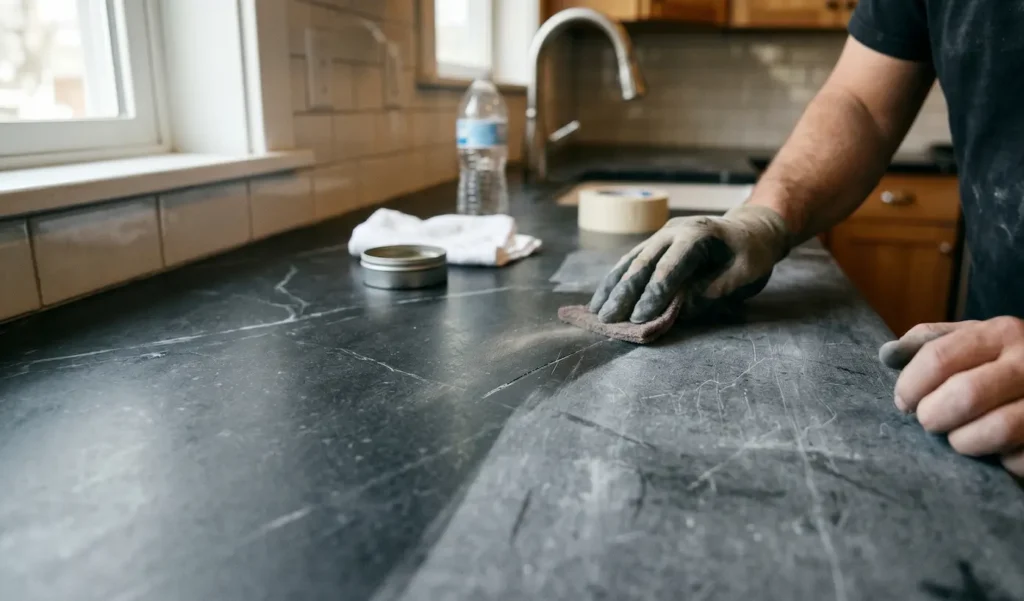
Surface scratches The most common complaint. Soapstone’s softness means knives, appliances, rings, and general kitchen activity all leave marks over time. Light scratches tend to blend into the surface and can be part of the stone’s natural character, but deep or concentrated scratches in a focal area look like damage rather than patina.
Uneven color or patchy darkening When mineral oil has been applied inconsistently over time — or applied to only part of the surface — the stone darkens unevenly. Some areas appear much darker than others, creating a patchy appearance that looks like staining but is actually an uneven enhancement finish.
Dry or faded appearance Soapstone that has not been oiled in some time, or that has had its surface oil depleted by heavy cleaning, can look chalky, faded, or lighter than intended. The stone is not damaged — it simply needs refreshing.
Water marks and mineral deposits Even though soapstone does not stain easily from liquids, hard water and mineral deposits from faucets and soap dispensers can leave visible marks around sinks and fixtures, particularly on bathroom vanity tops.
Food residue and cooking buildup Kitchen countertops accumulate cooking oils, residue, and buildup in surface texture and around edges over time. In commercial settings like restaurant prep counters and bar tops, this buildup can become significant.
Edge wear The edges and corners of soapstone countertops are particularly vulnerable to chipping and wear from regular contact. Edge profiles can become rough or inconsistent over time, which is especially noticeable on thicker slabs or decorative edge profiles.
Old mineral oil buildup Paradoxically, too much mineral oil — or oil that has been applied without proper surface preparation — can itself become a problem. Instead of absorbing cleanly, excess oil sits on the surface, attracts dust and residue, and creates a greasy, uneven appearance.
Can Soapstone Scratches Be Removed?
Yes, in most cases — though the approach depends on the depth of the scratch and the current finish level of the stone.
Light surface scratches are often the easiest to address. Because soapstone is soft, it can be worked with fine abrasives that blend the edges of the scratch into the surrounding surface, making it far less visible or effectively invisible in the overall texture of the stone.
Moderate scratches require more careful attention — working the affected area with progressively finer abrasives to smooth and blend the surface without creating an uneven patch of different texture or sheen relative to the surrounding stone.
Deep gouges or chips are more challenging but often still repairable. Depending on the depth and location, a professional technician may fill and blend the area before refinishing the surrounding surface to match.
One important nuance: because soapstone develops a natural patina over time and is typically treated with mineral oil that affects its appearance, any mechanical refinishing needs to account for the current state of the entire surface — not just the scratched area. Refinishing a single spot without addressing the surrounding surface can result in a visible mismatch. Professional restoration addresses this by treating the surface as a whole, not as isolated repairs.
What Happens During Soapstone Countertop Restoration?
Stone Guys NY’s professional soapstone restoration services follow a structured process designed to address the full condition of the surface and deliver a consistent, refreshed result.
1. Inspection A technician assesses the current state of the countertop — scratch depth and distribution, finish consistency, degree of darkening, presence of buildup or residue, and any edge damage. This determines what the restoration process needs to include.
2. Stone-safe cleaning The surface is cleaned thoroughly with products appropriate for soapstone — removing cooking residue, old oil buildup, mineral deposits, and surface contamination that would interfere with the refinishing process.
3. Removal of residue or buildup Old mineral oil that has accumulated rather than absorbed, as well as any wax or product residue, is carefully removed to give the technician a clear, clean surface to work with.
4. Scratch blending and refinishing Using appropriate abrasives and techniques for soapstone’s softness, the technician works scratches and surface inconsistencies to blend them into the surrounding stone. The goal is a uniform surface texture — not a different texture than the stone started with.
5. Surface smoothing Once the major work is done, the surface is refined to a consistent finish — typically the matte or low-sheen character that soapstone is known for.
6. Optional mineral oil or enhancer application After the surface has been prepared, mineral oil or a compatible stone enhancer may be applied to deepen and even out the stone’s color. This step is discussed with the client based on the desired appearance.
7. Maintenance guidance The restoration is only as durable as the care that follows it. The Stone Guys NY team will walk through appropriate cleaners, oiling frequency, and daily habits that keep the stone looking its best.
Should Soapstone Be Sealed?
This is an important distinction that sets soapstone apart from most other natural stone countertop materials. Because soapstone is non-porous, it does not absorb liquids in the way that marble, limestone, or granite do — which means the primary purpose of sealing porous stones (preventing liquid absorption and staining) is simply not applicable to soapstone.
Most soapstone surfaces are not sealed with an impregnating stone sealer. Instead, they are enhanced with mineral oil or, in some cases, a compatible stone wax. These products do not penetrate and fill pores (there are very few to fill) — they sit on or just below the surface and serve a different purpose: deepening and enriching the stone’s natural color, and providing a light protective layer against surface-level contamination.
The frequency and approach to mineral oil maintenance depends on the stone’s current state and the desired appearance. Freshly installed or recently restored soapstone may benefit from oiling once a month for several months until the stone has darkened evenly, then transitioning to a less frequent maintenance schedule. Older, well-darkened stone may only need occasional oiling to maintain its appearance.
A professional technician will assess the stone’s current condition and provide specific guidance on what products and frequency are appropriate for your surface.
Soapstone in Kitchens, Bars, and Fireplaces
One of soapstone’s great strengths is its versatility across a range of applications — each of which may require slightly different restoration and maintenance approaches.
Kitchen countertops The most common residential application. Kitchen soapstone typically shows the most wear — scratches from daily use, uneven oiling, cooking residue buildup, and edge wear are all common. Full-surface restoration with scratch blending and fresh mineral oil application can make a heavily used kitchen counter look dramatically better.
Bathroom vanity tops Generally receive lighter use than kitchen countertops, but are often affected by hard water deposits around fixtures, soap residue, and inconsistent oiling. Restoration focuses on cleaning, deposit removal, and surface evening.
Restaurant and bar tops Commercial soapstone surfaces see intensive daily use from cleaning chemicals, food preparation, spills, and service activity. Professional restoration for commercial spaces addresses heavy residue buildup, edge wear, and surface inconsistencies — and Stone Guys NY works with restaurant and bar operators throughout NYC to maintain these surfaces in working order. See the full range of Stone Guys NY’s stone restoration services for commercial applications.
Fireplace surrounds Soapstone fireplaces are a classic application, valued for the stone’s heat tolerance. Soot, smoke residue, ash marks, and surface inconsistency from years of use are the primary restoration concerns. Cleaning and surface refinishing can restore a fireplace surround to a clean, even appearance.
Sinks Integrated soapstone sinks are prone to mineral deposit buildup from water exposure and often develop scratches from cookware and cleaning tools. Restoration focuses on deposit removal, scratch blending, and surface evening.
DIY Soapstone Care vs. Professional Restoration
For routine daily maintenance — wiping the surface with a mild stone-safe cleaner, applying mineral oil periodically, and using cutting boards and trivets — most soapstone owners can handle care themselves. The stone is forgiving and does not require the careful product selection that marble or limestone demands for everyday cleaning.
Professional restoration is a different matter. It is the right choice when:
- Scratches are deep, concentrated, or in a visible focal area where surface blending by hand has not produced a satisfactory result
- The surface has darkened unevenly and simple re-oiling has not corrected the patchiness
- Old oil, wax, or product buildup has accumulated to a degree that routine cleaning cannot address
- Edge damage — chips, rough areas, or inconsistent profiles — needs repair
- The countertop is in a commercial space where appearance standards and maintenance frequency requirements exceed what in-house cleaning can maintain
- A full refresh is desired — taking the stone back to a clean, even baseline before resuming regular maintenance
The investment in professional restoration typically extends the maintenance cycle significantly. A properly restored and freshly oiled soapstone surface is easier to maintain consistently going forward than one that has accumulated years of unaddressed wear.
How to Maintain Soapstone After Restoration
Keeping a professionally restored soapstone surface looking its best requires consistent, simple habits:
- Clean with a mild, stone-safe soap or pH-neutral cleaner — avoid harsh degreasers, bleach-based products, or anything abrasive that can strip the oil finish or scratch the soft surface
- Avoid abrasive scrub pads unless specifically advised by your restoration professional — these leave fine scratches that accumulate over time and dull the surface
- Apply mineral oil evenly and consistently — when re-oiling, apply to the full surface rather than spot-treating; uneven oiling is the primary cause of the patchy appearance that prompts most restoration calls
- Use cutting boards for all food preparation — soapstone can handle heat, but knife marks accumulate and affect the surface appearance
- Wipe spills promptly — not because soapstone stains easily, but because letting cooking oils, wine, or coffee sit on the surface can leave residue that alters the oil finish
- Keep maintenance consistent — a regular oiling schedule (monthly for a period after restoration, then as needed based on appearance) is far more effective than heavy periodic treatments after extended neglect
Frequently Asked Questions About Soapstone Restoration
Can soapstone countertops be refinished? Yes. Soapstone’s softness makes it well-suited to refinishing — surface scratches, uneven texture, and inconsistent finish can be addressed through professional abrasive work and surface treatment. The goal is a consistent matte surface that matches the natural character of the stone, refreshed and evened out.
Does soapstone need sealing? No — not in the way that marble or limestone does. Soapstone is non-porous and does not require an impregnating sealer. Most soapstone surfaces are instead treated with mineral oil or wax to enhance and even out the stone’s natural darkening, which is a maintenance treatment rather than a protective sealer.
Can scratches be removed from soapstone? Most surface scratches can be blended or significantly reduced through professional refinishing. Deep gouges may require filling and blending before refinishing. The soft nature of the stone is actually an advantage here — it responds well to abrasive work in ways that harder stones do not.
Why does my soapstone look uneven? The most common cause is inconsistent mineral oil application over time. When some areas of the stone have been oiled more than others — or when oil has been applied to a dirty surface — the stone darkens unevenly. Professional cleaning and restoration, followed by a fresh, even mineral oil application, typically resolves this.
Is soapstone good for restaurant or bar tops? Yes, with appropriate maintenance. Soapstone’s resistance to heat, staining, and acid make it well-suited to commercial food and beverage environments. The softness that makes it prone to scratching in residential kitchens is less of a concern when the surface is maintained professionally on a regular schedule. Many high-end NYC restaurants and bars use soapstone precisely for its durability and distinctive appearance.
Refresh Your Soapstone Surface with Stone Guys NY
Scratched, uneven, or faded soapstone does not need to be replaced. With professional restoration — cleaning, refinishing, scratch blending, and fresh mineral oil enhancement — most soapstone countertops, bar tops, and fireplace surrounds can be brought back to a consistent, refreshed appearance that honors the stone’s natural character.
Ready to restore your soapstone surface? Contact Stone Guys NY for professional soapstone countertop restoration in NYC. We work with homeowners, restaurant and bar operators, designers, and property managers throughout Manhattan, Brooklyn, Queens, the Bronx, and beyond.


LEAVE A COMMENT